GE Aerospace 2025
Annual Report
Dear Fellow Shareholder,
At our manufacturing site in Terre Haute, Indiana, there is a tape dispenser nicknamed “The Gerald,” and it is changing everything.
Terre Haute is home to more than 300 GE Aerospace employees who specialize in the production of combustors and structures for both commercial and military aircraft engines. In 2023, the turbine center frame (TCF) line, a critical component for the CFM1 LEAP engine that powers the Airbus A320neo and Boeing 737 MAX aircraft, had an on-time delivery rate of 20%, far from the goal of 100%. Something had to change. The team identified a need for an electronic tape dispenser to replace a time-consuming manual step in the process that required cutting individual pieces of tape with a utility knife to label the build and protect holes on the turbine center frame from foreign objects.
The new automated tape dispenser was expensive, causing Gerald Beuvelet, the plant leader, to ask the team to provide extensive justification for the request. That's how it had always been done. The team was disheartened. The long bureaucratic approval process would kill the positive momentum that had been building on the line. Looking at the team’s slumped shoulders as they left the room, Gerald realized he had it wrong. He wasn’t listening to the people who knew what was needed to drive immediate improvement. He purchased the tape dispenser on the spot, no more questions asked.
One tape dispenser did not solve all the challenges at the site, but it did begin to change the culture.
The team on the shop floor felt empowered by the trust shown to them and started actioning more and more improvements. Today, on-time delivery of the TCF line is 96%, supporting the overall 28% increase in LEAP output in 2025. Now, “The Gerald” — proudly named after their beloved plant leader — stands for something bigger than just the tape it dispenses; it stands for a shared commitment to being better by listening to those closest to the work.
Starting our annual shareholders letter with a story of a tape dispenser is unconventional, but it perfectly represents the culture we are forging at GE Aerospace. One rooted in the behaviors of Respect for People, Customer Driven, and Continuous Improvement and guided by FLIGHT DECK, our proprietary lean operating model, to deliver for customers.
While 2024 was marked by big moments and bright spotlights as GE Aerospace launched as an independent public company, 2025 was defined by countless small, impactful moments that together, were just as significant. It is the compounding effect of these seemingly minor, incremental changes where FLIGHT DECK is making a meaningful difference.
With nearly one million people in the air right now with GE Aerospace and our partners’ technology underwing, every detail matters. Our 57,000 employees come to work every day to invent the future of flight, lift people up, and bring them home safely. The weight of that responsibility drives a relentless focus on safety, quality, delivery, and cost (SQDC), always in that order.
Safety First, Always
In 2025, the aviation industry was struck by tragedies . The heartbreak from American Airlines Flight 5342, United States Army Black Hawk PAT25, Air India Flight 171, and UPS Flight 2976 was felt deeply across our industry. In addition to supporting our customers through these dark moments, we at GE Aerospace also lost one of our own. Vikesh Patel, a dedicated and influential leader, was returning home from a work trip on Flight AA5342. As we continue to grieve his loss, we are reminded every day of our purpose statement and shared responsibility.
Safety is always our top priority. We never compete on safety, because nothing matters more.
1CFM is a 50/50 Joint Venture between GE Aerospace & Safran Aircraft Engines

In 2025, the aerospace supply chain continued to face two competing challenges: recovering from a constrained and fractured post-pandemic environment while simultaneously ramping to meet one of the greatest periods of demand the industry has experienced. Our supply chain is complex and deeply interconnected, with more than 500 direct suppliers supporting our ability to deliver for customers. From material availability to labor shortages and geopolitical dynamics, obstacles to achieving our production commitments continued to persist – making this the perfect time for problem solving, not finger pointing.
Our work began with a candid acknowledgment of our shortcomings and an understanding that we must become better partners not only to our suppliers externally, but to our teams internally as well. In January, we combined our safety, quality, engineering, manufacturing, and sourcing teams into a single, cohesive organization. This unified team is fostering stronger problem solving and alignment across the value chain internally, thereby enabling more effective communication with our external supply base. In 2026, we are committed to building off of this progress as we expand this team to manage the entire commercial engine lifecycle.
As one team, we changed how we deliver demand signals to our suppliers, providing them with more stable short-term forecasting in addition to greater visibility into long-term demand. Now we are able to partner more closely to deploy FLIGHT DECK and GE Aerospace engineering resources into our supply base. With shared humility and determination to resolve challenges, together we are strengthening systems and processes to work better for everyone.
Take for example one of our supplier partners which specializes in the brazed honeycomb assembly surrounding CFM’s LEAP engine turbine blades. The supplier had a process in place that was averaging an output of 47 pieces per week, yet customer demand was much higher. To help close the gap, a team of 40 employees across GE Aerospace and our supplier leveraged FLIGHT DECK to come together for a kaizen event to analyze the production system, improve processes, and unlock capacity. Through value stream mapping, the team was able to pinpoint four key areas of constraint and put changes in place that increased the average output to more than 470 pieces per week since the kaizen event, a tenfold increase.
This is demonstrating Respect for People – empowering our teams on the ground with trust to do what is needed to make a process better for everyone involved.
By leading with Respect for People and deploying FLIGHT DECK across the supply base, we are driving sustained impact. In 2025, material input from our priority suppliers grew 40% year-over-year, with seven consecutive quarters of sequential improvement. As material availability improved, total engine deliveries were up 26% year-over-year. Commercial Engines & Services (CES) deliveries grew 25%, including record LEAP deliveries up 28%, and Defense deliveries growing 30% for the year.

At our Maintenance, Repair, and Overhaul (MRO) site in Celma, Brazil, roughly 30 airline customers depend on our teams to service four different engine lines: CFM56, LEAP, GEnx, and CF6. Celma is responsible for approximately 25% of total internal shop visits for GE Aerospace, with LEAP engines accounting for roughly 21% of the site’s volume in 2025. While we expect LEAP shop visits to continue growing, the team has faced persistent turnaround time delays, extending the time it takes to get our customers’ fleets back in the air. Committed to relieving this bottleneck, the team has advanced its FLIGHT DECK transformation journey over the past year to pinpoint constraints, establish standard work to improve consistency, and implement daily and visual management to rapidly identify and resolve abnormalities. As a result, the team has achieved a 23% reduction in LEAP test cycle time since August 2024, improving every day so that customers can receive their engines faster.
This is being Customer Driven.
It starts with measuring our performance through the eyes of our customers — seeing ourselves as they do, not as we hope they would. While our team delivered outstanding financial results in 2025, we are not satisfied, because our customers are not satisfied. From delivery to durability, we have more work to do to meet our customers’ expectations. We are committed to predictability, improved time-on-wing, and lower cost of ownership.
For instance, we are advancing our LEAP durability roadmap to enhance the engine’s performance, especially in hot and harsh environments. By the end of 2025, the reverse bleed system (RBS), which helps to extend the life of the engine’s fuel nozzles, has been installed in 50% of LEAP-1A engines in service, and nearly 1,500 LEAP-1A durability kits have been shipped to customers across new engine production and global overhaul shops since certification. These upgrades will help to deliver meaningful improvements in the field, increasing time-on-wing by more than twofold, matching our industry-leading CFM56 performance and we expect certification for the LEAP-1B durability kit in the first half of 2026.
To improve predictability and cost of ownership, we are leveraging artificial intelligence (AI) to enhance our aftermarket capabilities and accelerate turnaround times. Well before engines arrive in our shops, we’re using AI to not only reduce the maintenance burden of inspections but also improve inspection accuracy. Developed at the GE Aerospace Research Center, our AI-enabled Blade Inspection Tool is facilitating the inspection of critical stage 1 blades to be done in half the time with improved accuracy . With the knowledge we gain through inspections, we’ve also developed an AI-based material assistant that can predict the shop visit workscope for individual LEAP engines nine months in advance, driving more accurate material forecasting before shop visits to enable earlier part orders. We deployed this model to our Celma and Malaysia MRO facilities in 2025 and are already seeing five-to-seven-day reductions in turnaround time.
As we look to 2026, we know the expanded use of AI will be an accelerator for FLIGHT DECK, reducing waste and providing more time for our teams to focus on the most value-added work for our customers. With the data and analysis AI can provide in minutes, if not seconds, we can take our FLIGHT DECK journey to an even higher level.
We are relentlessly pursuing technology innovations like these to better serve our customers and deliver on what they value.

Our facility in Lynn, Massachusetts designs, produces, assembles, and tests military and commercial aircraft engines — including the F404. Leveraging FLIGHT DECK, the team pinpointed key areas that were creating bottlenecks on the F404 high pressure turbine (HPT) shaft line, including shot peen, wet blast (a surface finishing process), and turning operations. During wet blast, media would settle at the bottom of the machine, causing an hour of lost time each time they ran parts through. In November, the team focused on redesigning the fixture and installed an air bubbler to prevent settling. This eliminated more than an hour of setup time per batch and removed a daily loss of three to five hours from this process. This one small improvement, combined with other similar changes across the value stream, has contributed to a 49% lead time reduction for the HPT shaft.
This is Continuous Improvement, a mindset derived from the belief that we can get better every day.
Building off an installed base of 80,000 engines and 2.3 billion commercial flight hours, we don’t rest — we draw from our lessons in the field to constantly enhance our processes and platforms.
Take the GEnx. After it entered service in 2011, our engineers set out to improve the HPT blade’s performance in hot and harsh environments. Realizing that heat and dust were playing a significant role, the team fine-tuned our dust ingestion testing to better simulate real-world conditions. This allowed us to prove out new durability upgrades that have resulted in the GEnx’s time-on-wing to more than double in harsh environments, while also creating the durability testing standard that all our engines now follow.
We continue to draw on these learnings as we prepare our next engines for the field. Just look to the GE9X, which will be our most tested engine in history when it enters service to power Boeing’s 777X. With more than 30,000 cycles of testing, including 9,000 endurance cycles, we are preparing this engine now for what it will experience in various conditions in the years to come.
Through the CFM RISE program, we are focused on advancing a suite of technologies that will power the next generation of flight, including Open Fan, compact core, hybrid electric, and alternative fuels. The architecture of Open Fan is the most promising path to achieving a 20% step change in durability and efficiency for next-generation narrowbody aircraft. It offers a new jet engine design that removes the traditional casing, allowing for a larger fan size with less drag to improve fuel efficiency — a key concern for our airline customers. Additionally, to accelerate our progress on hybrid electric flight, we are partnering with BETA Technologies to co-develop a hybrid electric turbogenerator while we continue to work with NASA to advance hybrid electric propulsion technologies for flight tests.
In total, RISE has completed over 350 tests and more than 3,000 endurance cycles. This includes dust ingestion testing that began in 2025 on next-generation HPT airfoils — the first time we’ve done this in the technology development phase, ensuring durability is woven into the work from the beginning.
Ultimately, as we advance new technologies, we are not only informing future applications but also applying those learnings across our current platforms — for both commercial and defense.
This approach to improvement through innovation further extends into the work we are doing to support a rapidly evolving threat landscape. We know we play a vital role in powering the warfighters who defend freedom. It is a no-fail mission and one that drove us to increase defense engine deliveries by 30% in 2025.
That mission also drives our ongoing development for next-generation aircraft programs — whether that's in support of the Next Generation Adaptive Propulsion program (NGAP) with the XA102 or the F/A-XX program. We are also focused on delivering differentiated capabilities that can support demand across collaborative combat aircraft (CCA) and unmanned platforms. Throughout 2025, we took steps to expand our work in this space, partnering with innovative disruptors to accelerate technology development and bring capability to the field faster. We expanded our partnership with Kratos to advance propulsion technologies for small, affordable unmanned aerial systems and CCA-type aircraft. At the same time, we are taking opportunities to innovate on our proven propulsion systems. Our F110 engine, which has four decades of continuous production, was selected to power Shield AI’s autonomous vehicle, capable of vertical takeoff and landing. Regardless of platform, we stand ready to deliver and help ensure the United States maintains air superiority.
We know that relentless innovation is key to our future. That is why, together with our customers, we’re investing nearly $3 billion in research and development2 annually, knowing it may be decades before we see any meaningful returns. The CFM LEAP program broke even for the first time in 2025, roughly nine years after it entered service, and it will take two decades for us to recover our initial investment. We wouldn’t have it any other way. The bets we take to improve our services and equipment are worth it to deliver value to our customers and invent the future of flight.
2Amount represents research and development as reported in our 2025 10-K and includes customer and partner funding.
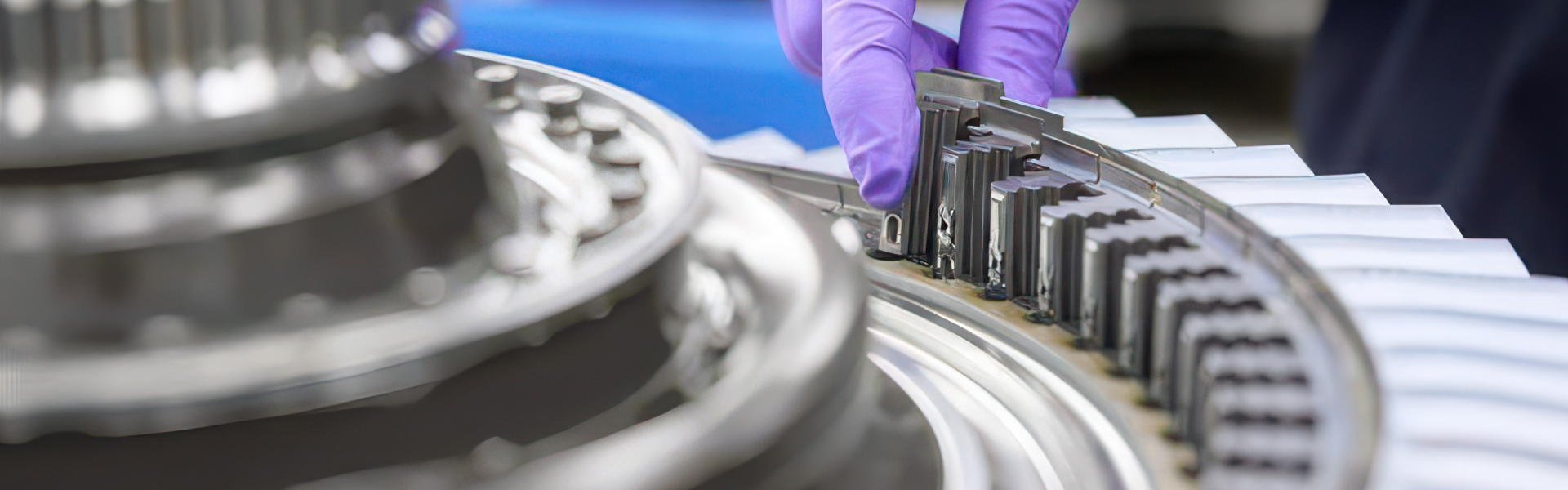
One tape dispenser. One test cell. One hour removed from a process. The great basketball coach John Wooden once said, “It’s the little details that are vital. Little things make big things happen.” At GE Aerospace it’s the small things that matter most to us because together, they enable the big things, like inventing the future of flight.
The small gains built from FLIGHT DECK also turn into pervasive operational improvements that are underpinning our financial results. This was reflected in our 2025 performance as adjusted revenue* increased 21%, and total orders grew 32% year-over-year. Our operating profit* increased 25% to $9.1 billion, and our free cash flow* was up 24% to $7.7 billion. We grew our backlog by nearly $20 billion to roughly $190 billion as demand for our services and engines remained robust.
While our financial performance in 2025 was certainly encouraging, our aspirations are not about having a solid quarter or year — it's about having a great decade. With our behaviors and FLIGHT DECK at work at every level of the company, there is no limit to what we can achieve.
*Non-GAAP financial measure