- Engineering centers in Germany, Italy, Poland and Türkiye play key roles to advance the future of flight
- HYDEA model displayed at ILA Berlin
BERLIN – GE Aerospace (NYSE: GE) announced today at ILA Berlin new test milestones reached for the development of next-generation engine technologies in Europe including hybrid electric systems and hydrogen combustion.
“Avio Aero and GE Aerospace teams in Europe are proud to be at the forefront of new technology innovation. Together with our European partners and research institutions, we're turning ideas into real, tested capability,” said Luca Bedon, head of research and technology at Avio Aero, a GE Aerospace company headquartered in Italy.
These recently completed test campaigns support global technology development for the CFM International RISE* program in collaboration with government, industry and other innovation partners, including Clean Aviation.
“Avio Aero has been a longstanding and dedicated member of the European aeronautics research ecosystem and has played a key role in successive public-private partnerships, from Clean Sky to Clean Aviation. Its ongoing commitment reflects the strength of European industrial collaboration in delivering groundbreaking technologies for a more sustainable next generation of aircraft,” said María Calvo, head of project management at the Clean Aviation Joint Undertaking.
HYDEA: Hydrogen test proves altitude relight capability
Teams from Avio Aero, as well as GE Aerospace in Germany, Poland and Türkiye, completed the company’s first test for engine restart using hydrogen in simulated altitude conditions. Tests were conducted at the DLR Institute of Space Propulsion in Lampoldshausen, Germany.
Hydrogen fuel burns faster and hotter than conventional jet fuel. The campaign addressed one of the most demanding requirements for flying with hydrogen: the ability to relight an engine quickly and reliably in thin, cold air at high altitude.
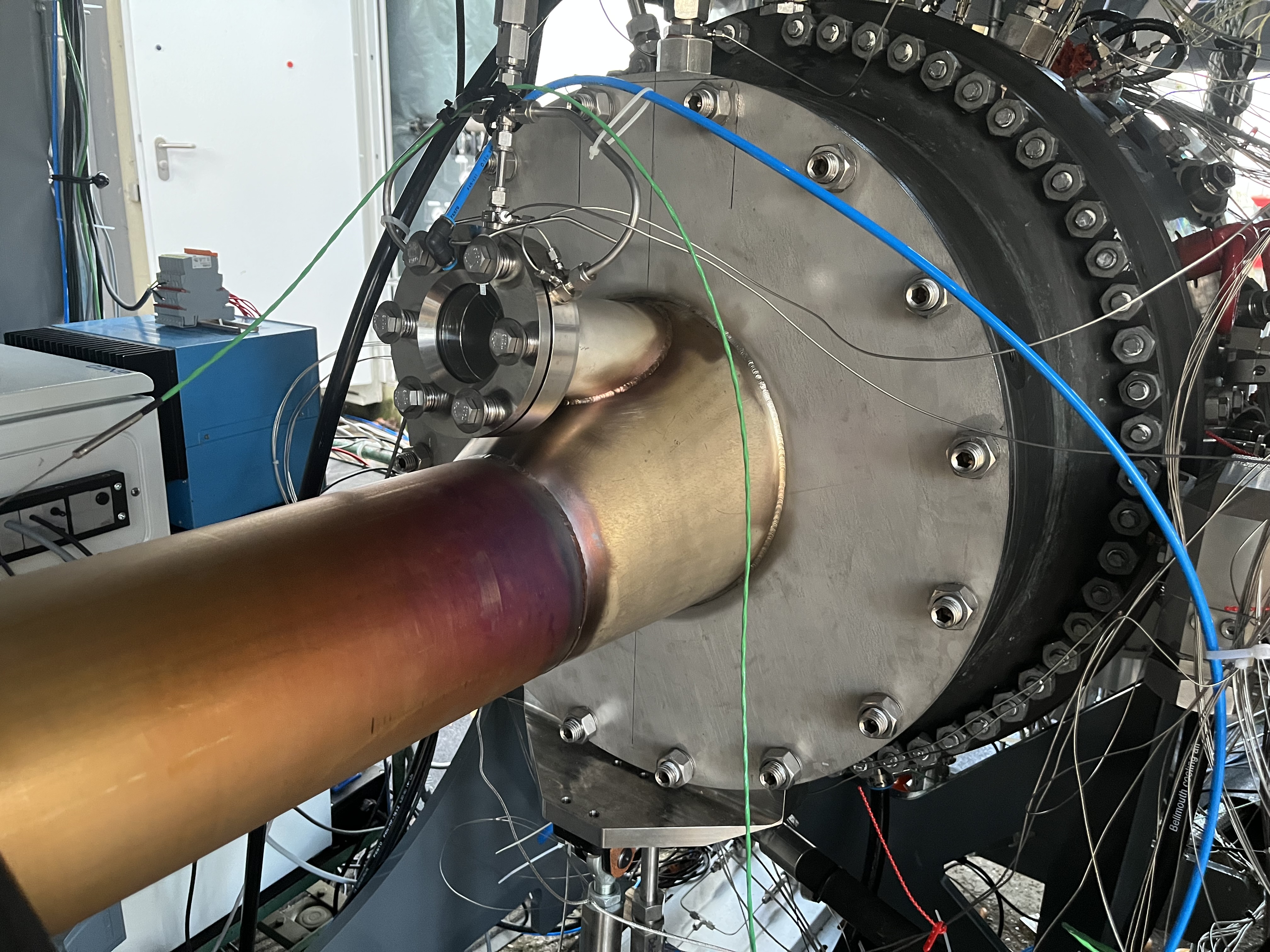
Working with DLR, the team built a custom hydrogen sector combustor test rig with a synthetic air generator. The test used vaporized liquid oxygen and nitrogen to replicate the very dry air at flight conditions and successfully established a relight operability envelope. The ignition system used in the test campaign was designed and manufactured by Unison** specifically for hydrogen operation.
A key element of the successful test campaign was the use of a multi-cup hydrogen sector combustor, providing a more realistic geometry and optimal igniter placement compared to a single cup sector. At the advanced test rig, engineers were able to observe cup-to-cup flame propagation as well as igniter-to-flame interactions using DLR’s high-speed camera system.
The team will now apply data and operability insights to design a full annular hydrogen combustor test rig.
Hydrogen combustion technologies are being advanced as part of the HYDEA Clean Aviation project consortium led by Avio Aero.
AMBER: Fuel cell system demonstrated
Testing has now wrapped on a proprietary fuel cell system at the DLR BALIS test facility, marking another milestone on the path towards hybrid electric propulsion systems for aviation.
As part of the Clean Aviation project AMBER, DLR collaborated with Avio Aero and the GE Aerospace team in Munich, Germany, to support development of technologies for a megawatt-class hybrid electric propulsion system. The AMBER program looks to demonstrate the integration of fuel cells, power electronics and an electric drive.
DLR’s test campaign for AMBER validated fuel cell dynamic behavior from idle to maximum power in short transient times, and resilience of the full system under various power modes simulating short- and long-range flight operations. This provides a better understanding of operational performance and durability.
“The future of flight is more electric. We're proud to partner with DLR and others around the world to advance the building blocks to help make hybrid electric flight a reality,” said Roman Seele, future of flight leader for GE Aerospace in Germany.
Advancing more efficient flight in Europe
Avio Aero is a founding member of the European R&D program Clean Aviation. Avio Aero and GE Aerospace engineering centers in Germany, Italy, Poland and Türkiye are partnering on multiple Clean Aviation projects for ground and flight tests this decade:
- TAKE OFF & OFELIA, focused on Open Fan ground and flight test demonstrators to accelerate advanced propulsion technologies led by Safran Aircraft Engines;
- AMBER, which is advancing a megawatt-class hybrid electric propulsion system powered by fuel cells; and
- HYDEA, which is progressing hydrogen combustion technology.
Unveiled in 2021, the CFM RISE program is one of the aviation industry’s most comprehensive technology demonstrators with more than 350 tests and more than 3,000 cycles of endurance tests completed to date, including tests on advanced engine architectures like Open Fan, compact core and hybrid electric systems. The RISE program prioritizes safety, durability and efficiency, targeting more than 20% better fuel burn compared to commercial engines in service today.
* Revolutionary Innovation for Sustainable Engines (RISE) is a technology demonstration program of CFM International, a 50-50 joint company between GE Aerospace and Safran Aircraft Engines. It is not a product offered for commercial sale.
** a GE Aerospace company
###
About GE Aerospace
GE Aerospace is a global aerospace propulsion, services, and systems leader with an installed base of approximately 50,000 commercial and 30,000 military aircraft engines. With a global team of approximately 57,000 employees building on more than a century of innovation and learning, GE Aerospace is committed to inventing the future of flight, lifting people up, and bringing them home safely. Learn more about how GE Aerospace and its partners are defining flight for today, tomorrow, and the future at www.geaerospace.com.
About Avio Aero
Avio Aero is a GE Aerospace company that designs, manufactures and maintains components and propulsion systems for civil and military aviation. Today, the company provides its customers with innovative technological solutions to quickly respond to the continuous changes required by the market: additive manufacturing, rapid prototyping, as well as technologies dedicated to the production of transmissions, turbines, and combustors. The company's head office is in Rivalta di Torino, where its largest production facility is also located. Other important facilities are situated in Brindisi and Pomigliano d'Arco (Naples), with a total of more than 4,900 employees employed in Italy. Abroad, it has a plant and a test center in Poland and a production and testing facility in the Czech Republic, with a total of around 1,100 employees.
GE Aerospace media contact:
Chelsey Levingston
513-720-6458
chelsey.levingston@geaerospace.com