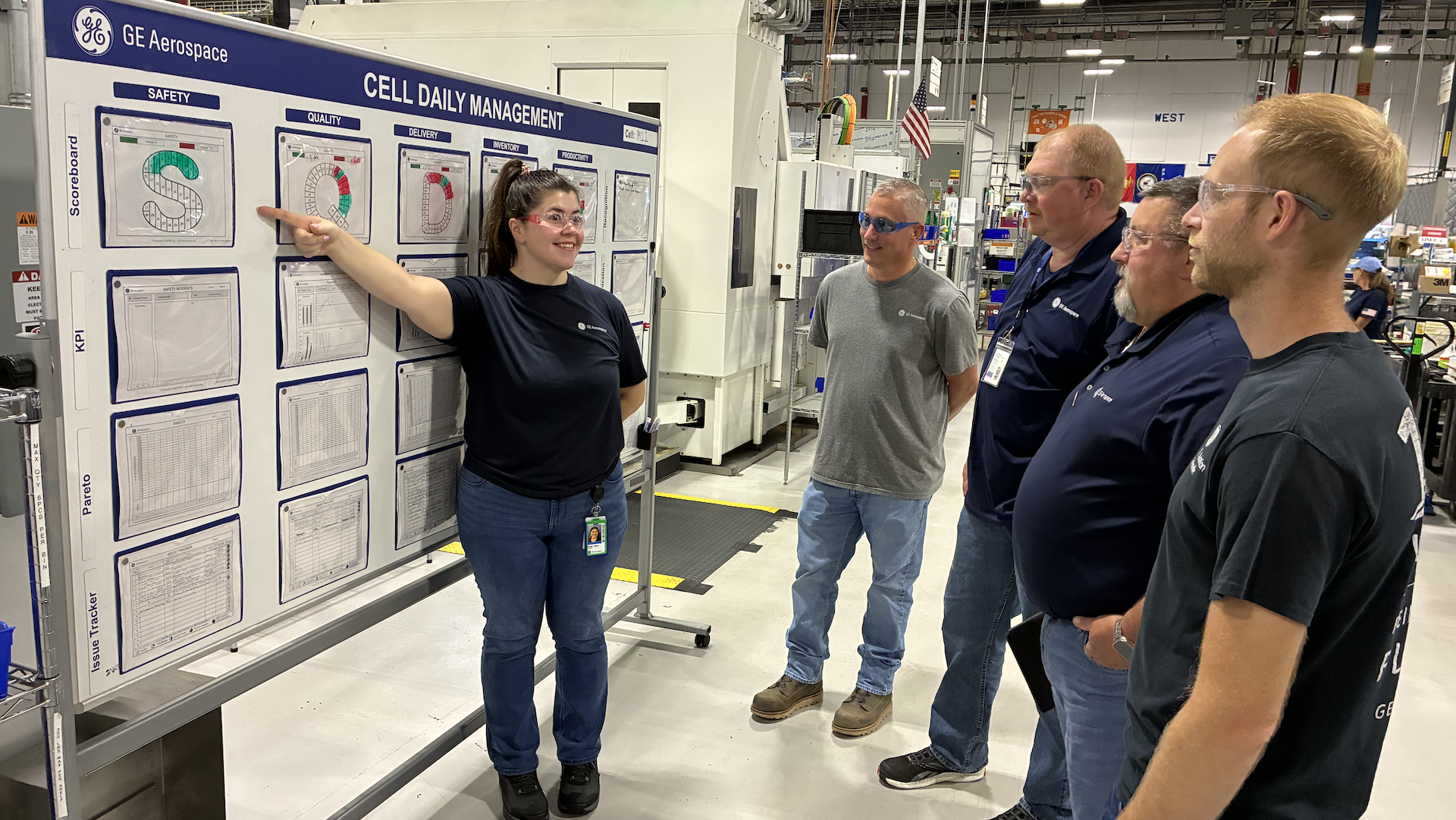
Greenville teams meet regularly to review safety, quality, delivery, and cost (SQDC) metrics and problem-solve as needed. From left: Skylar Upton, Josh Campbell, Kevin Glenn, Keith Ausburn, and Ross Krieg. Images credit: GE Aerospace
Article
FLIGHT DECK Is the Not-So-Secret Sauce Strengthening Team Safety and Performance in Greenville
June 11, 2026 | by Dianna Delling
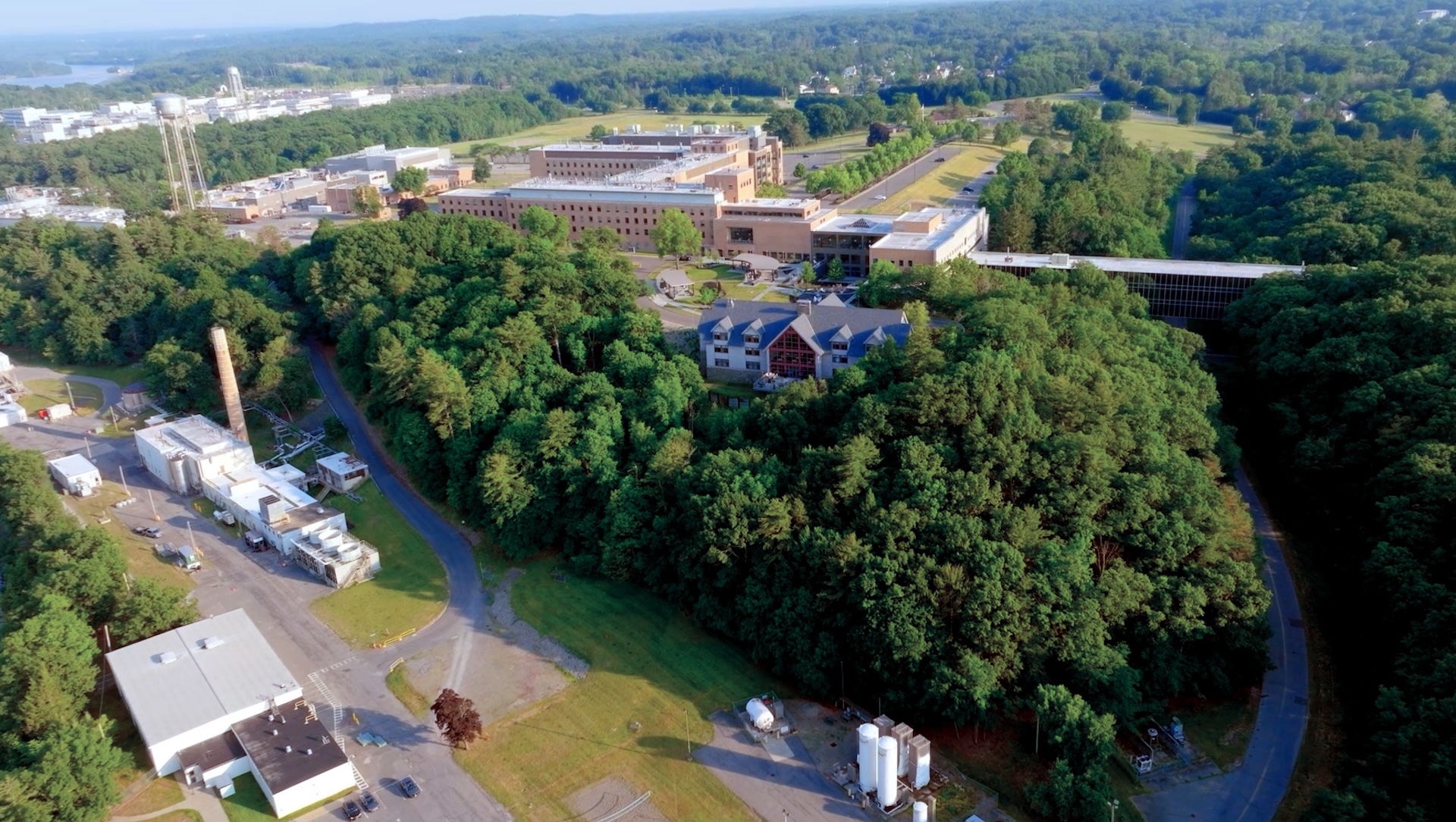
At various points throughout the day, leaders at the GE Aerospace site in Greenville, South Carolina, can be seen walking the shop floor to observe where the work happens. Genba walks, as they’re known in lean management, provide an up-close look at processes and procedures in the 150,000-square-foot facility, where skilled technicians produce high-pressure turbine (HPT) blades for most of the company’s commercial engine models. Leaders ask questions, hear directly from operators, and work with the team to address issues before they become problems.
Genba walks are not optional; they’re part of how the Greenville plant operates. In fact, the genba walk is just one of many routine practices that support the site’s remarkable safety record, which was recently recognized with a 2026 GE Aerospace Altitude Award — a top honor in the business. While expanding the workforce by 35%, adding more than 150 new machines and supporting equipment, and increasing output from 2024 to 2025 by 35%, the Greenville site has not experienced a significant employee injury or incident in more than three and a half years.
“To be just under four years without a recordable [incident] is the result of a tremendous effort and a deliberate mindset by the entire team,” says Christopher Ubillus, Greenville plant leader.
While he and his colleagues are proud of the milestone, they are not resting on it. They stay grounded in the commitment to safety, quality, delivery, and cost — always in that order. At the Greenville facility, FLIGHT DECK, GE Aerospace’s proprietary lean operating model, shapes how work is done, from daily and visual management to standard work to kaizen events. Ubillus says that this disciplined way of working has been key to their success, both for the team and their customers.
Leaning into FLIGHT DECK
Lean principles have shaped how the Greenville team has operated since day one. After opening in 2004, the 40-person shop adopted an approach called teaming — empowering a workforce and building consistency through standardization. This means that each machine operator has been trained to work in every position on the production lines, and they rotate duties daily. Those early choices helped shape the site’s operations. When the plant moved to a larger location in 2010, these practices scaled with it, laying the groundwork for the operating discipline now strengthened through FLIGHT DECK.
“If you tour our production lines, you’ll see that most are very similar to one another,” says Ubillus. “Operators can go anywhere and know exactly what to expect and how that environment will produce positive results for them relative to safety.”
That standardization and consistency is intentional. Through FLIGHT DECK, when an operator moves to a different line, they don’t have to relearn where hazards might be — the layout, visual management, and routines make “the safe way” also “the normal way.” That repeatable design reduces variation, reveals abnormalities quickly, and allows people to focus their energy on improving the process.
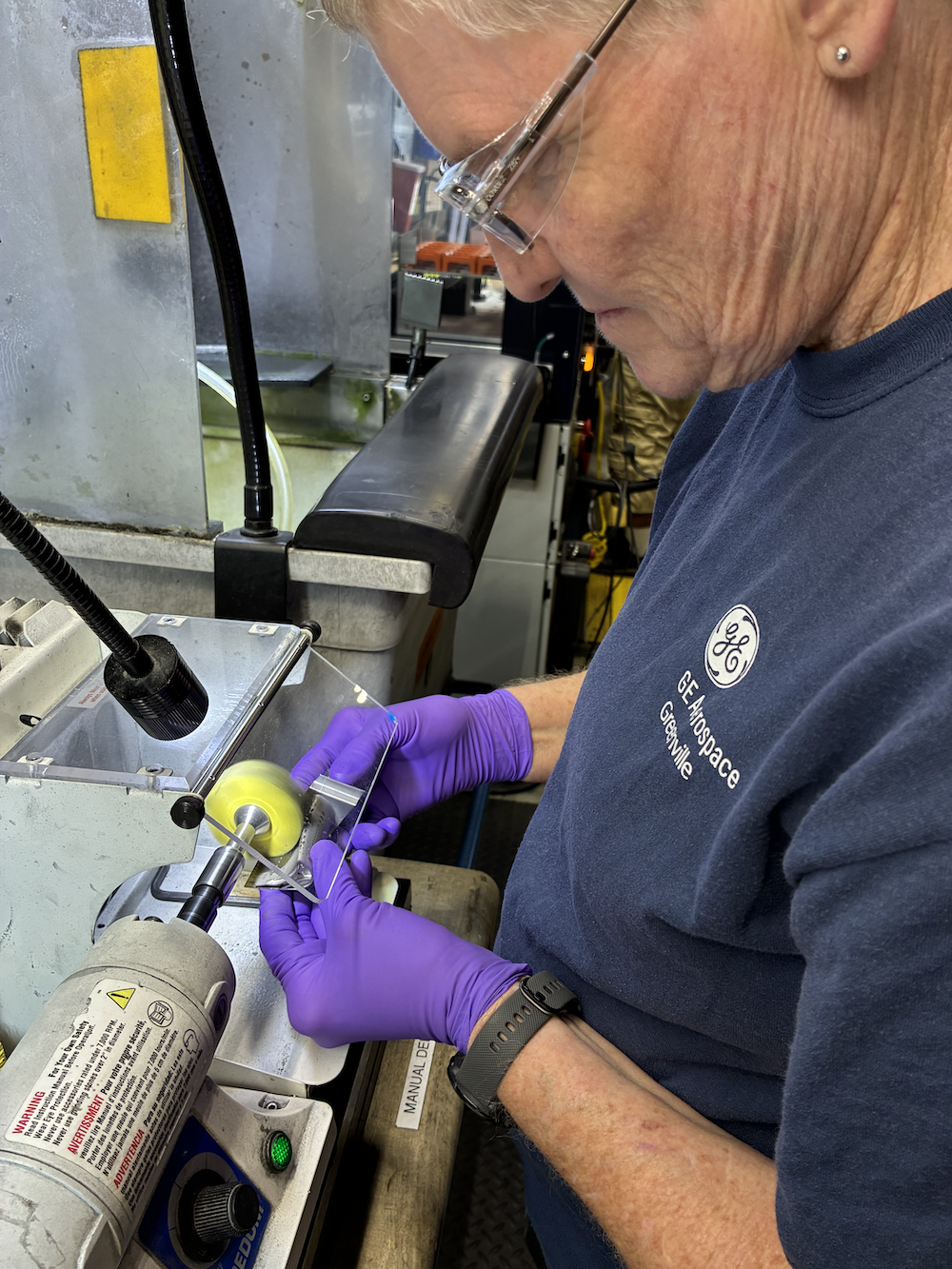
Today that’s as important as ever, as the site’s 350-person workforce continues expanding to keep up with soaring demand for its products. In addition to manufacturing HPT blades for GE90 and GE9X engines, the plant also supplies blades for the CFM LEAP engine, produced by CFM International, a 50-50 joint company between GE Aerospace and Safran Aircraft Engines. In March, GE Aerospace announced a $33 million investment in the Greenville facility to advance grinding, laser drilling, and other machine systems, as well as upgrades to inspection technology — part of the company’s larger $1 billion investment in manufacturing sites across the United States.
FLIGHT DECK, launched in 2024, has provided a framework for managing this rapid growth, helping the team develop standard work and operating cadences that ensure decisions are grounded in safety.
“It’s the way we work, across our entire organization,” says Ubillus. “Consistency in our behaviors is important to us, so we don’t miss anything. Over time, these disciplined behaviors have been woven into our culture, which then has numerous benefits — not only from a safety standpoint, but in terms of the quality of our products, efficiency of our operations, and how we deliver for our customers.”
Continually Improving Workplace Safety
Staying incident-free at the Greenville plant is not about keeping a scoreboard; it is about making sure every person goes home safe at the end of every shift. On their FLIGHT DECK daily management boards, that commitment shows up in simple terms: The highest-level key performance indicator (KPI) remains at green (successful) when there are no recordable incidents or injuries and no past-due concerns or actions, reflecting the team’s goal of “come to work safe, go home safe.”
Still, Ubillus is careful not to define safety only by what hasn’t happened. He and his team track more detailed safety goals to surface risk early and create opportunities for intervention before an injury occurs.
“We can’t just look at ‘Did we have an injury or not?’ because at that point, it’s too late for us to assess what we need to do about it,” says Ubillus. “We challenge ourselves to look at different proactive or leading indicators — maybe it’s the number of opportunities that we found daily to prevent risk from being present in the workplace.”
Analyzing each step in a process helps uncover where change is needed. Ubillus views that practice as central to a commitment to continuous improvement and ongoing discipline that guards against complacency.
“We have an environment that we’re proud of, with plenty of room for improvement, so we turn to ‘What can we do better? Where is the next incident likely to occur?’” he says.
Recognizing that employee satisfaction drives quality and safety, Ubillus champions a supportive culture for employees. Coaching is a key part of his leadership approach, as is creating an environment where team members feel safe not only physically but mentally. At the Greenville site, the team views safety as their collective responsibility, speaking up and sharing concerns as part of a site-wide commitment to keeping one another safe.
“All of this derives from FLIGHT DECK,” he says. “It’s our commitment to respecting people as we turn strategy into real results, drive continuous improvement, and deliver for customers while protecting what matters most — the people doing the work.”
See other posts
GE Aerospace is a world-leading provider of jet and turboprop engines, as well as integrated systems for commercial, military, business and general aviation aircraft.