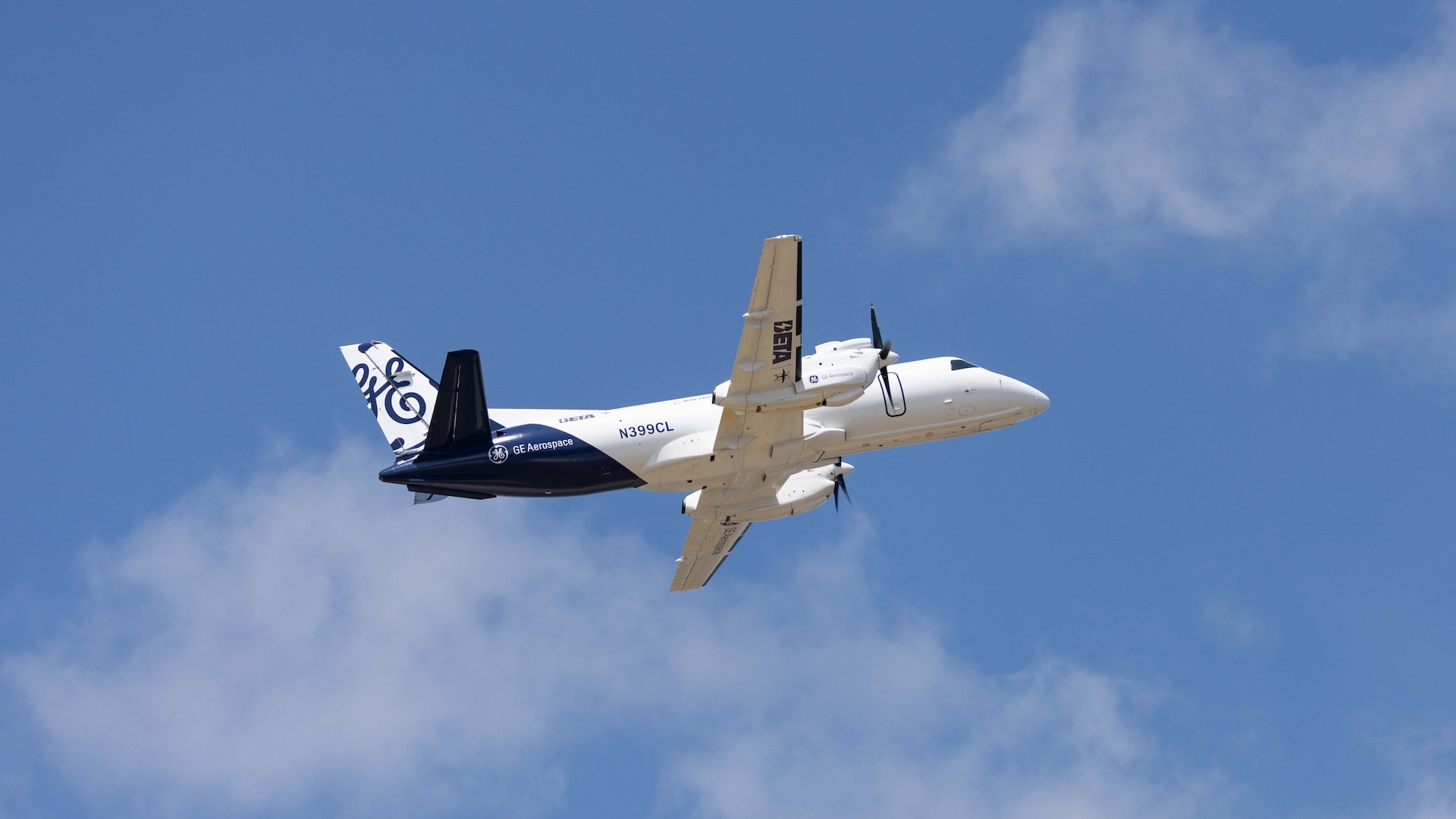
A modified Saab 340B aircraft in flight powered in part by a hybrid electric system built by GE Aerospace, along with NASA, BETA Technologies, and Boeing. Image: GE Aerospace
Article
The Future of Flight Takes Off: GE Aerospace Showcases Advancements at Farnborough International Airshow
July 20, 2026 | by Cole Massie
Walk into any GE Aerospace facility in the world and you’ll likely encounter the words “We invent the future of flight.” That phrase, the first part of the company’s purpose statement, isn’t a contrived display reserved for bare hallways and computer screen savers. It’s happening in real time — and more than 2,000 engineers in the United States, France, Germany, India, Poland, Türkiye, and beyond are committed to bringing the next wave of propulsive technology to bear.
This week, GE Aerospace leaders will showcase their vision for the future as the aviation world converges near London for the Farnborough International Airshow (FIA). There, they’ll highlight the company’s latest achievements in hybrid electric technology and advanced propulsion, including Open Fan architecture. And they’ll share testing triumphs that underscore how next-generation innovations decades in the making are rapidly maturing.
Accelerating Hybrid Electric Flight
As GE Aerospace heads into FIA, Cincinnati-based executive engineering leader Christine Andrews is prepared to showcase the notable hybrid electric advancements in the future of flight technology portfolio. Her team is aiming to prove out a high-performing, scalable hybrid electric propulsion solution. While hybrid electric vehicles are now common on the road, sustained hybrid electric flight has been elusive. Now, however, Andrews’ team has amassed the data and testing records to show that hybrid electric flight is well on its way to becoming a reality. And they’re getting closer to a point where the technology can be scaled across engine architectures.
“I think most people would love to say they were part of a team that achieved a world first in their field,” Andrews says. “We’re doing it consistently. The records we’re breaking in hybrid electric propulsion are our own. We’ve got a team that has really built a strong bond and has a relentless prioritization and focus on advancing hybrid electric technology.”
Each time Andrews’ team brings its hybrid electric testing to a higher altitude, to a different part of the flight envelope, or on a longer test, they’re mapping out an uncharted aviation landscape. Just last month, GE Aerospace highlighted her team’s work, announcing they had successfully completed ground tests of a megawatt-class hybrid electric engine system, working with NASA’s Electrified Powertrain Flight Demonstration (EPFD) project. The ground tests yielded higher power output and higher voltage than competing hybrid electric offerings. What’s more, Andrews’ team — working with NASA, BETA Technologies, and Boeing — recently conducted the first hybrid electric test flight above 30,000 feet. The modified aircraft flew for more than two hours in hybrid operation, the aviation industry’s longest hybrid electric flight to date.
“It’s been exhilarating for us,” says Andrews. “Farnborough gives us the opportunity to share our progress with customers and show them this future isn’t a theory or concept — the future is now.”
Perfecting Open Fan Architecture
Hybrid electric systems are highly compatible with alternative fuels and advanced engine architectures — including the Open Fan architecture to be featured at Farnborough. Unlike traditional ducted engines, Open Fan utilizes one rotating fan and a second stationary fan with outlet guide vanes to direct airflow, which significantly increases propulsive efficiency.
Alex Simpson, who leads Open Fan and compact core engineering development at GE Aerospace, says the Open Fan design beat out a host of competing next-generation engine designs because it enables a significant gain in fuel efficiency while also improving durability — both top concerns for airline and airframer customers looking to build their future fleets. It’s also a key goal for GE Aerospace in its partnership with Safran Aircraft Engines on the CFM RISE* program. RISE is advancing a suite of demonstrator technologies — Open Fan, hybrid electric, and “compact core” technologies for a smaller and highly efficient engine core — aimed at producing a 20% improvement in fuel efficiency compared with today’s commercial engines, along with the durability enhancements.
“Work like this is why I became an engineer,” Simpson says. “To get a 20 percent reduction in fuel burn, you have to change something pretty significantly. Open Fan architecture is the only architecture that can get you the gains we’re after.”
“What we’re sharing at Farnborough is how incredibly far we are in terms of this technology,” he adds. “We’ve got advanced systems tests of large parts of the engine ongoing, and we’re working with our partners and advancing our understanding of how it integrates into an airframe. We’re much closer to the end than to the start.”
Next Stop: Flight Demonstrations
The question that will be on people’s minds at Farnborough is a natural one: When will we see these technologies in use?
The answer is “very soon.”
David Davies, site leader for the GE Aerospace Flight Test Operations facility in Victorville, California, notes that his flight test team worked with Andrews’ team on the integration of hybrid electric technology into a modified Saab 340B test bed for the most recent commercial-grade flight testing. He says that the experience was pivotal for scaling up tests of hybrid electric technology, as well as plans to introduce Open Fan architecture and other CFM RISE technologies on GE Aerospace’s 747 Flying Test Bed.
“The Flying Test Bed is a unique asset,” says Davies. “We can take everything we’ve learned on the ground, put it in real-world flight envelopes, and gather incredible amounts of performance data that tell us the technology is working as expected. It’s a competitive differentiator for us — both the aircraft and the team behind it.”
Tackling a shift this significant — redefining how the world flies — is the ultimate engineering challenge. It requires not just isolated breakthroughs by Andrews, Simpson, or Davies’ teams, but a focused, synchronized, and global effort to integrate these technologies into future engine platforms.
“There aren’t many companies in the world who can take on a challenge like this,” Simpson notes. “But GE Aerospace is one of them.”
* Revolutionary Innovation for Sustainable Engines (RISE) is a technology demonstration program of CFM International, a 50-50 joint company between GE Aerospace and Safran Aircraft Engines. It is not a product offered for commercial sale.
See other posts
GE Aerospace is a world-leading provider of jet and turboprop engines, as well as integrated systems for commercial, military, business and general aviation aircraft.