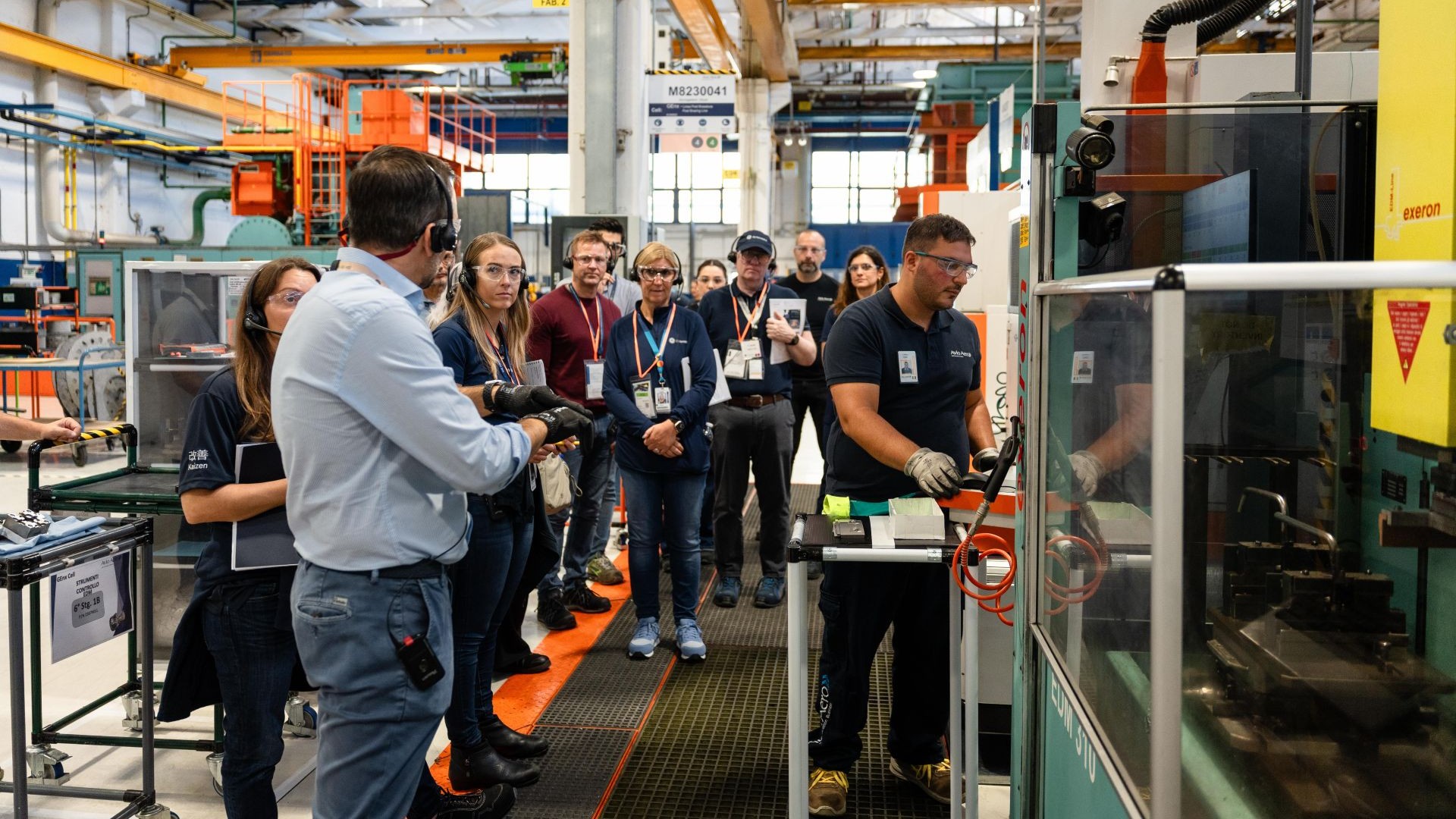
Earlier this year, Avio Aero team members conducted a kaizen event at the Pomigliano site, which helped them earn the prestigious 2026 Altitude Award for Site Breakthrough. Images credit: GE Aerospace
Article
It’s Aero Dynamic: How Avio Aero’s Pomigliano Site Is Using FLIGHT DECK to Streamline Production and Boost Productivity
July 30, 2026 | by Chris Noon
The shop floor team at GE Aerospace’s Avio Aero plant in Pomigliano d’Arco, a suburb in northeast Naples, Italy, excels at producing precision-made blades, combustors, and other components for some of the world’s largest civil and military engine programs. As site leader Roberto Bertaina notes, they’re also experts in turning spaghetti into gnocchi.
OK, not literally. But the famous Italian dishes are code words in their mission to replace long, complex workflows with shorter, more efficient ones. Bertaina carries with him a map diagram of the 2022 production-line journey of a stator vane — a fixed component inside a jet engine that helps direct airflow through the engine for better performance. “This is our spaghetti diagram,” he says, using the technical term for the chart, which shows the component zigzagging around the shop floor for different operations, looping back to the same workstations for grinding, deburring, and inspection. Hiding within the spaghetti were opportunities to simplify a circuitous route and drive progress to meet takt time, the pace of work needed to keep production aligned with customer demand. There was also the chance to reduce inventory costs, as technicians were using extra materials and tools each time the component came back to them.
Bertaina and his team tackled the tangles by doubling down on FLIGHT DECK, GE Aerospace’s proprietary lean operating model, using daily management, visual tools, and in situ problem solving to run and continuously improve shop operations. The holistic approach is paying off: The team has identified and eliminated hundreds of meters of travel, consolidated tasks, and reduced inventory costs associated with the stator vane’s journey around the shop floor. “It’s route now looks more like a ‘gnoccho’,” says Bertaina, referring to the component’s efficient, oval-shaped path.
The team has already leveraged the FLIGHT DECK fundamentals, a set of lean tools, on 12 key ramp-up production lines at Pomigliano to achieve a 20% boost in labor productivity, a 42% reduction in inventory costs, and a 42% reduction in lead time. In acknowledgment of their transformative work, they received the company’s prestigious 2026 Altitude Award for Site Breakthrough. And they continue to improve. “We’re on track to double our conversion speed [compared with 2022],” says Bertaina, referring to the time taken to turn raw materials into finished parts. “We’re going to make Pomigliano even more competitive.”
A Lean Journey
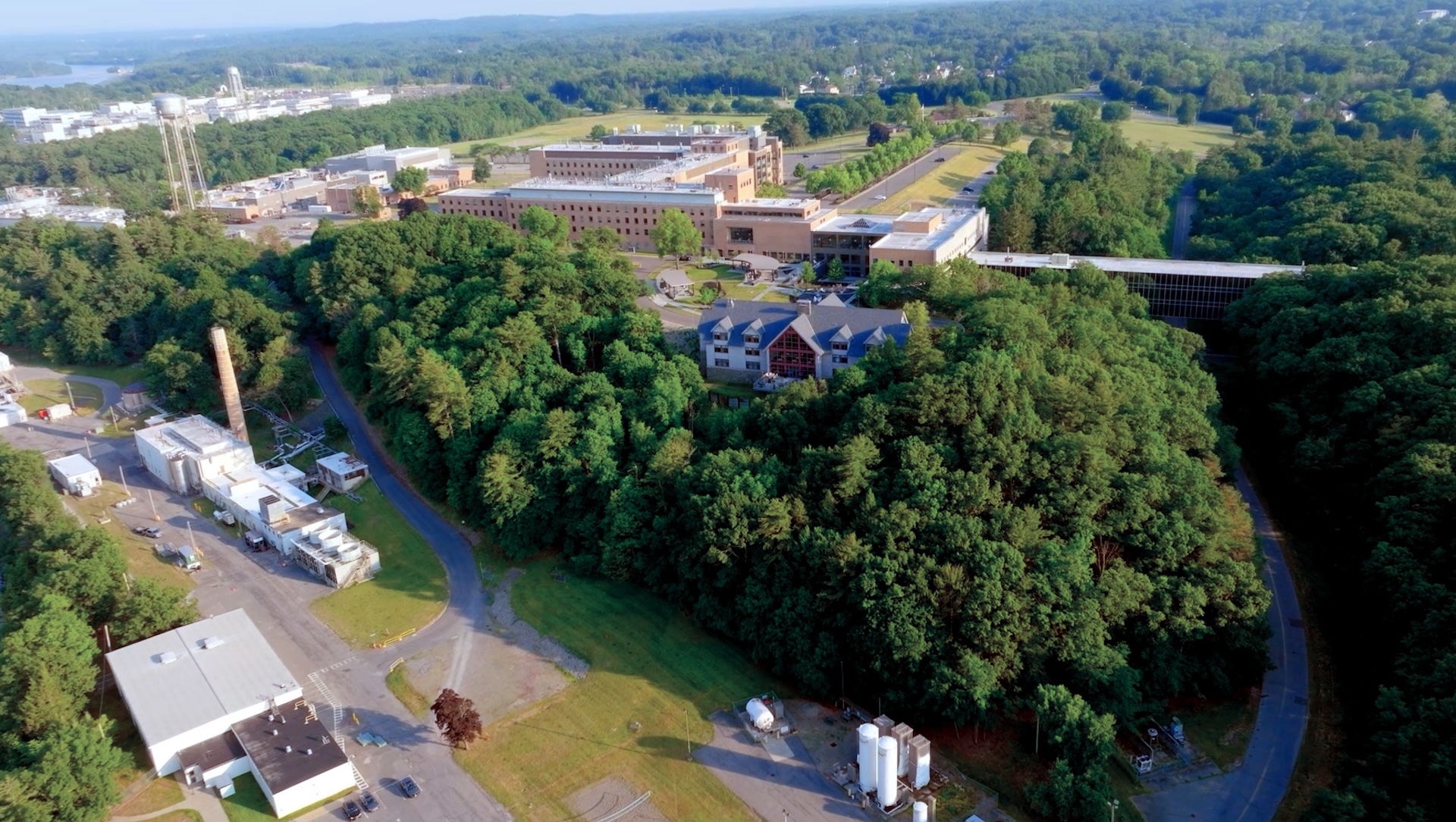
Pomigliano is a key hub in GE Aerospace’s mission to invent and deliver the future of flight. The facility produces components for programs including the CFM LEAP* engine, the record-breaking GE9X engine, and the Eurojet EJ200 engine, the powerplant of the Eurofighter Typhoon. The company has ramped up investments in Pomigliano since acquiring Avio Aero in 2013, expanding the site’s production and service capacity and upgrading its manufacturing technologies.
As with any operation, there are always opportunities for continuous improvement. “For some lines, we had several weeks of delinquency,” says Bertaina, referring to the production backlogs and delivery delays of the mid-2010s.
In 2018, Pomigliano’s plant managers embraced lean management. Shop floor teams launched weekly management meetings in their production areas, the so-called “point of impact,” to track the four “true north” performance metrics: safety, quality, delivery, and cost, always in that order. This framework continues to guide how GE Aerospace measures performance and drives operational improvement. The weekly stand-ups helped yield effective solutions to long-standing challenges.
Eventually the meetings became a daily occurrence. When Bertaina arrived at the plant in 2022, he noticed small crowds — “quality, maintenance, manufacturing, technology, and design engineers” — converging on production lines before shifts. “I was lucky,” he says. “The team was already working cross-functionally to solve SQDC issues together in real time … and they had been doing it for years”

A Deep Dive
Pomigliano’s managers trained their sights on the LEAP and GEnx engine programs. “We mapped every program,” says Bertaina. “We went straight to the ones where we could drive the most impact.”
They left no stone unturned. Cross-functional teams recorded and mapped every single manufacturing step, whether it was a long grinding process or a quick final inspection. At one of Pomigliano’s 15 control centers — booth-like spaces equipped with screens and audio situated on the shop floor — teams analyzed, identified, and eliminated any non-value-added steps.
Take that spaghetti diagram. After analyzing it, a shop floor team identified two competing workflows that were impacting delivery. “We had parts moving round the shop to different machines, and different parts coming to the same machine,” says Bertaina. “That generated waste in terms of waiting, because the same machine operator was prioritizing one workflow over another.” The frequent return trips of the component to workstations were also incurring inventory costs.
Removing or consolidating tasks streamlined the workflow traffic. “We found we were doing four grinding operations, and we could go down to two. We also decided to do both grinding operations in a sequenced, linear way,” says Bertaina, explaining that mini-queues around a single bench were more efficient than journeys across the shop floor. The redesign yielded an improvement in both productivity and takt time attainment, which enhanced delivery while helping to maintain safety standards and quality.
Today, Pomigliano has roughly 60 active problem-solving efforts in motion at any given time, most of them driven by issues raised at the point of impact. Since Pomigliano manufactures around 3,000 individual components, these initial efficiency gains are just the tip of the iceberg. Bertaina is aiming to apply these learnings more broadly across the plant in the coming years.
“It’s highly structured collaboration in action,” he says. “And it all starts on the shop floor.”
* CFM LEAP engines are produced by CFM International, a 50-50 joint company between GE Aerospace and Safran Aircraft Engines.
See other posts
GE Aerospace is a world-leading provider of jet and turboprop engines, as well as integrated systems for commercial, military, business and general aviation aircraft.