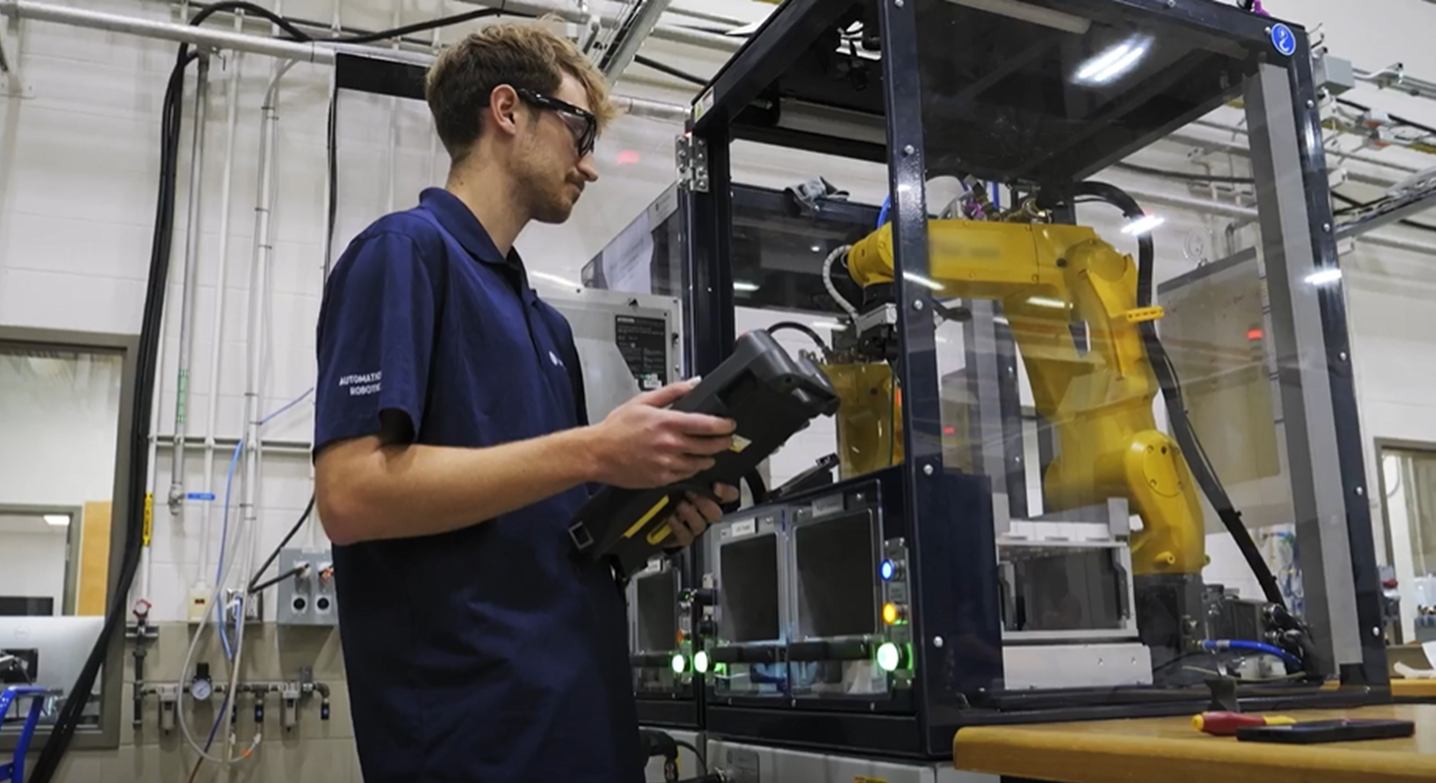
An engineer at GE Aerospace’s facility in Bromont, Quebec, being assisted by a remote expert via smart glasses and the PwC Field Sight Frontline Services solution to troubleshoot a robotic gripper in the robotics lab. Image credit: GE Aerospace
Article
Through the Looking Glass: GE Aerospace’s AR Demos Showcased at CES in Las Vegas
April 21, 2026 | by Brendan Coffey
Hundreds of attendees worked their way through PwC’s Business Acceleration Lounge during the Consumer Electronics Show in Las Vegas in January. More than a few wrapped “smart glasses” around their heads, which in turn helped them wrap their heads around the future.
Here’s what it looked like: First, guests were invited to try on a pair of smart glasses and start a remote support call using PwC’s Field Sight Frontline Services solution. Next, they called a humanoid robot via the smart glasses and asked it to hand-deliver a component. They then placed the component into a simulated work cell, where they initiated a Microsoft Teams call with a remote expert. Talking to the remote expert through the smart glasses, they fulfilled a set of instructions to complete the work cell robotics routine.
“The whole interactive experience was three to five minutes long, but it really illustrated the remote support context,” says Nic Sabo, a senior engineer in technology development, who is leading GE Aerospace’s effort around augmented reality (AR), virtual reality (VR), and 3D technologies. Sabo, who was on hand to represent the company in the PwC booth, says the demonstration sparked a slew of conversations around the possibilities of POV technologies. Such as: “Is there a future where a pair of AR eyeglasses can help me get contextual help from a remote expert?” And: “Could we have agentic AI be the remote expert and have it contextualize the information coming through the camera feed?”
Sabo suggests the answer is very much yes. Even before the company split into three separate entities, “GE was very active in this space,” he notes. “Augmented reality has been a training tool across the board.”
Helping Customers by Speeding Up Training
For GE Aerospace, a major step toward embracing the power of these technologies has come through training for service bulletins on the CFM LEAP* engine. Using 3D and AR at the Customer Technical Education Center (CTEC) in Cincinnati, the company has slashed training time on the reverse bleed system retrofit for the LEAP-1A and -1B engines from five days to just about three. Using AR, GE Aerospace has found it can replicate much of the information contained in a 600-page field manual in visual form, displaying where parts are located, how to remove and install them, and other contextual visual clues.
In some sessions, Sabo says the use of 3D visual work instructions has helped the trainees complete the work roughly seven times faster: Teams using AR instruction removed 35 parts in the first three hours; using the traditional text-based manual, only five parts could be removed in the same time frame. In 18 months, GE Aerospace has used the AR tool to train hundreds of customers, he adds.
The gains at CTEC aren’t unique. At the company’s manufacturing facility in Pune, India, AR is being used in weld simulators to train apprentice welders. The augmented training provides a risk-free setting that eliminates the need for raw materials. Measured against traditional classroom-based instruction, welder training time at Pune has been cut 20%, leading to faster turnaround times, reduced operational costs, accelerated skill acquisition, improved precision, and lower error rates when trainees transition to real welding.
These advances are what encouraged PwC to approach GE Aerospace. The professional services firm created Field Sight Frontline Services, a productivity and intelligence solution, for smart glasses and collaborated with GE Aerospace to test it on real-world industrial use cases.
Ryan Hawk, PwC global energy and industrials leader, was also on the ground at CES and has seen firsthand the applications and promise of these types of solutions on the factory floor. “Wearable technology and remote expert models are becoming critical tools for productivity, cost reduction, and workforce resilience across industrial manufacturing,” explains Hawk. “Hands-free, real-time collaboration and instant access to knowledge empowers frontline workers and helps close the last-mile digital enablement gap that can be a challenge for enterprises with large frontline and distributed workforces.”
AR: An Over-the-Shoulder Partner
The ease of finding a use case came from another GE Aerospace innovation. Last summer, staff at the company’s Bromont, Quebec, facility approached Sabo’s team looking for a way to use AR to conduct remote support calls. Customers would call with a question or conundrum and inevitably would focus their phone’s video camera on the issue, only to have to put the phone down to use two hands, or generate a shaky video that made remote viewing more difficult.
In the PwC booth at CES, they displayed video reels showing how the Bromont staff is experimenting with smart glasses in a manufacturing setting to troubleshoot such issues. One example highlighted dealing with a robot gripper sensor that halts production, while another focused on the malfunction of a color-coded lighting system displaying the safety status in a given area of a plant.
Sabo sees a host of benefits coming as the technology matures. For starters, fewer emergency trips to customer sites may be required. And a reactive AR system could, over the longer term, improve the quality of GE Aerospace employees’ work: Rather than making an experienced worker go through a prescriptive list of actions, AR glasses would provide a less invasive, but more helpful, over-the-shoulder partner.
“The AI element would only interact with the user when it thinks they missed a step or observed something put in the wrong place,” says Sabo. “Then the worker isn’t fighting the AI and the interface; it’s just a passive thing observing the work and offering help only when needed.”
Practical applications in important, real-world situations like those identified by GE Aerospace engineers highlight the long-term promise of POV technologies in the industrial space. “As the technology has progressed, it’s getting more and more accessible,” Sabo says, “and is starting to converge with general user expectation.”
Which means the potential for educating customers and trainees faster and more seamlessly is getting more promising by the day. “In the future, AR combined with AI can help create more reactive workflows,” he adds, “improving quality by catching mistakes earlier in the process and shortening the training cycle by combining contextual information with on-the-job training.”
*CFM LEAP engines are produced by CFM International, a 50-50 joint company between GE Aerospace and Safran Aircraft Engines.
See other posts
GE Aerospace is a world-leading provider of jet and turboprop engines, as well as integrated systems for commercial, military, business and general aviation aircraft.