Article
A Well-Oiled Machine: GE Aerospace’s Quick-Turn Korean Crew Are Keeping This Japanese Cargo Carrier Cruising
May 18, 2026 | by Chris Noon
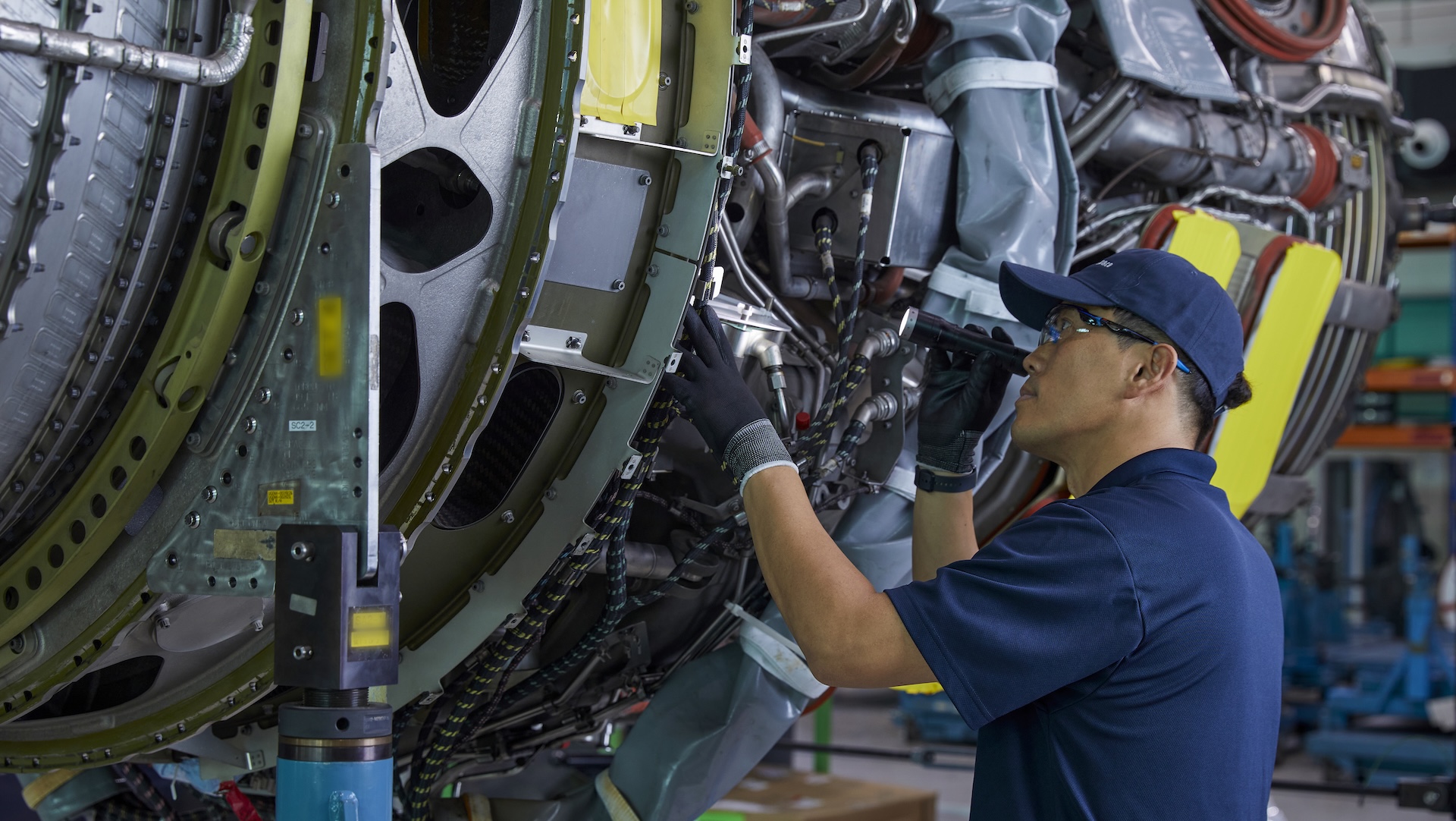
Wooyoung Kim might have felt a few butterflies on landing at Tokyo’s Narita International Airport last August. An aircraft maintenance technician at GE Aerospace, Wooyoung was the youngest member of the On Wing Support team based in South Korea, which had received an urgent call to replace a critical component on a GEnx engine mounted on a Boeing 747-8 freighter operated by Nippon Cargo Airlines (NCA). He and his fellow quick-turn crew were preparing for a slightly unorthodox repair job.
On paper, their task was straightforward: remove and replace the GEnx engine’s fuel manifold, the ring of pipes that feeds fuel to the nozzles. But the Korean crew would need to fix the engine “off-wing,” in line with Japanese regulations, which required detaching the 5.6-ton powerplant from the aircraft. They’d also be using an unfamiliar hoisting crane to lower the engine, rather than their regular machine back home in Gimpo, near Seoul. As if that wasn’t enough, NCA needed to get its freighter back flying ASAP, so there was no time to practice the high-stakes maneuver. “The pressure was on to complete the replacement within the fixed schedule,” says Wooyoung. The Korean OWS team had to nail the dismount on the first attempt.
Fortunately, the team had done their homework. Within hours of the job landing on their desk, they’d logged orders with GE Aerospace’s materials and maintenance teams, itemized and gathered their tools, and started shipping all the equipment to Japan. On arrival at Narita, they ran the standard engine condition and kit checks with their usual efficiency. Fortunately, help was at hand in the form of NCA’s engineers, who are experts in the art of off-wing maintenance.
Off-Wing and Off-Script
Working in tandem, the combined GE Aerospace OWS and NCA team began lowering the mighty GEnx engine. “We made an extra effort to work carefully and perfectly without any mistakes,” says Wooyoung. Their painstaking vigilance paid off. Very soon, they’d cushioned the GEnx engine on the ground like a sleeping baby. Within a week, they’d completed the fuel manifold replacement and returned home to Seoul. On landing, the OWS team heard the good news. “NCA had reinstalled the engine on the aircraft, performed a test, and successfully completed the work with no issues,” says Wooyoung.
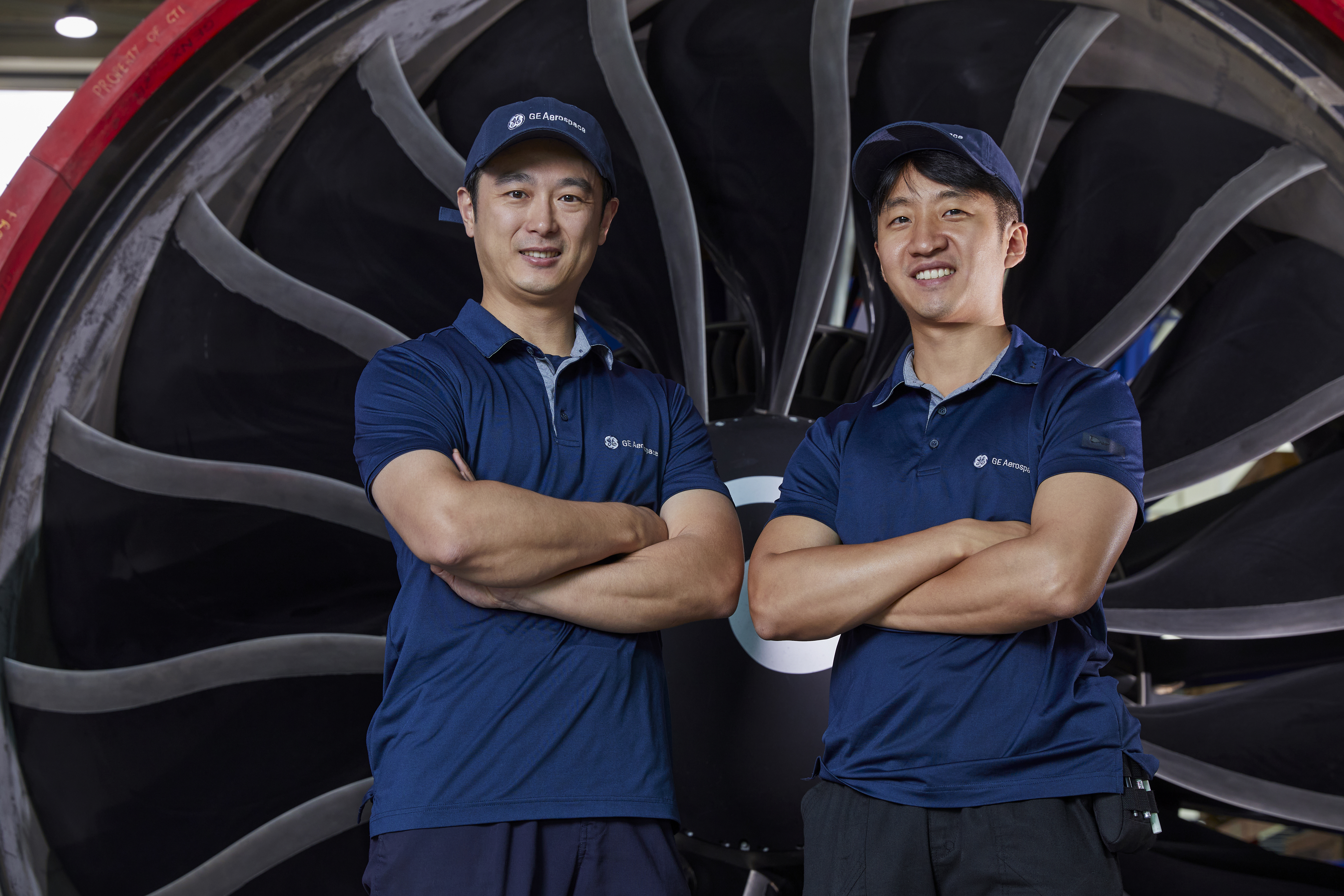
The smooth, seamless, and swift turnaround allowed NCA to return its freighter to service promptly and avoid costly delays to cargo deliveries. As a thank-you for the job, the Japanese carrier has presented the team that flew into Narita with a special plaque.
“GE Aerospace’s On Wing Support team has been a trusted partner in supporting our operations at Narita. Their technical expertise, responsiveness, and commitment to getting the job done right, every time, have enabled us to maintain schedule integrity and ensure the safe, reliable performance of our fleet," says Hideaki Kurita, executive officer, head of engineering and maintenance group at Nippon Cargo Airlines.
But Wooyoung and his colleagues are staying humble. “The award is for everyone in the Korean OWS team,” he says. “We’re improving our ability to deliver to customers with greater speed and certainty.”
A Collaborative, Conscientious, Capable Team
The plaque is yet another accolade for Ji-ock Kim, a technician who has worked on the Gimpo shop floor since it opened its doors in 2000. Over the past 26 years, Ji-ock has watched the Korean OWS site expand from just a handful of engineers into an 80-strong team that works out of a 72,100-square-foot facility and serves around 130 airlines across Asia and Oceania. As well as swelling their ranks, the crack squad of engineers have beefed up their tool kits and skill sets, explains the veteran engineer.
Ji-ock remembers the early years, when the team spent “many hours, many days” searching and making inventories of tools for field service jobs. But recently, through their use of FLIGHT DECK, GE Aerospace’s proprietary lean operating model, they’ve cut days off preparation for jobs by standardizing tool lists, and prepacking equipment in a single box as soon as the customer calls. Now, he says, “we just send this whole box at one time,” which reduces both lead time and costs for the customer.
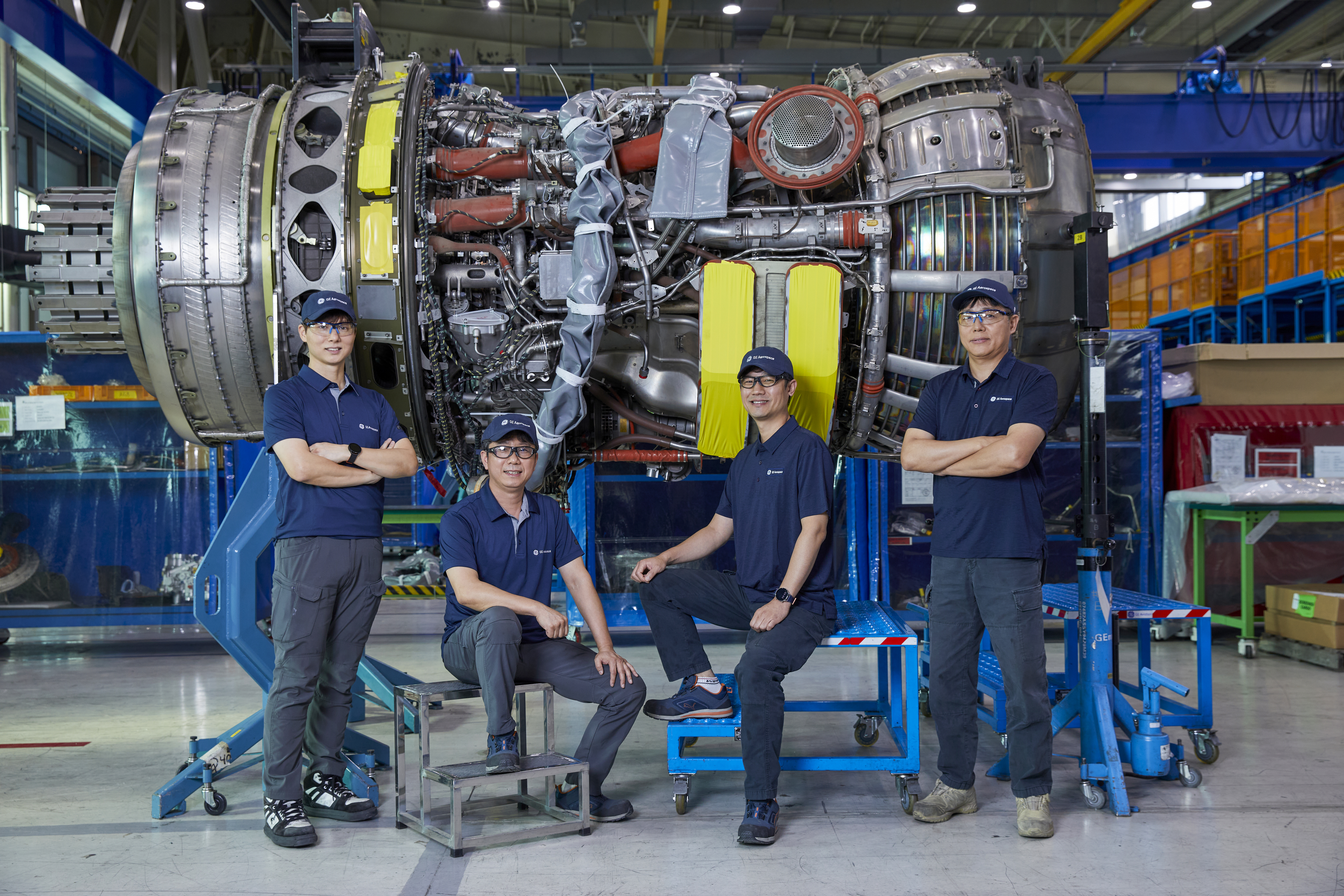
The impeccably prepared OWS engineers are a highly conscientious bunch. For example, they marry their meticulous preparation for field jobs with rigorous reviews of each day’s work, another improvement enabled by FLIGHT DECK. “We discuss whether there have been any mistakes, and share precautions for the next tasks,” says Wooyoung. They also value close collaboration. Field engineers are in continual communication with their planning, engineering, and materials and maintenance colleagues back in Gimpo to adjust work schedules, ensure high-quality maintenance, and receive the necessary support for equipment and tools.
The Korean OWS team works hand in glove with customers, too. Wooyoung, who has participated in nine of NCA’s 13 fuel manifold replacements, explains how the joint teams of engineers created “a very positive environment” while collaborating on the safe and efficient removal of each GEnx engine. The young technician says he’s witnessed a “remarkable improvement” in the team’s skills, working environment, and cooperation in recent years. “As a result, our job time gradually decreased, and we were able to carry out the work more efficiently and with higher quality,” he says.
In 2025, GE Aerospace invested $75 million in maintenance, repair, and overhaul (MRO) facilities in the Asia Pacific region, including the OWS site in Seoul, building on a $45 million investment the previous year. (All of this is part of the company’s global, multi-year plan to put $1 billion into its MRO network.) The result? New equipment will be installed to meet rising demand, and training programs for new employees and upskilling initiatives for current teams are being put into place.
Wooyoung is relishing the prospect. “Our expansion is not merely a matter of scale,” says the technician. “I believe it represents a clear enhancement of our capability to deliver to customers with greater speed and certainty.”
They’ll just have to make sure to save some space for all their awards.
See other posts
GE Aerospace is a world-leading provider of jet and turboprop engines, as well as integrated systems for commercial, military, business and general aviation aircraft.