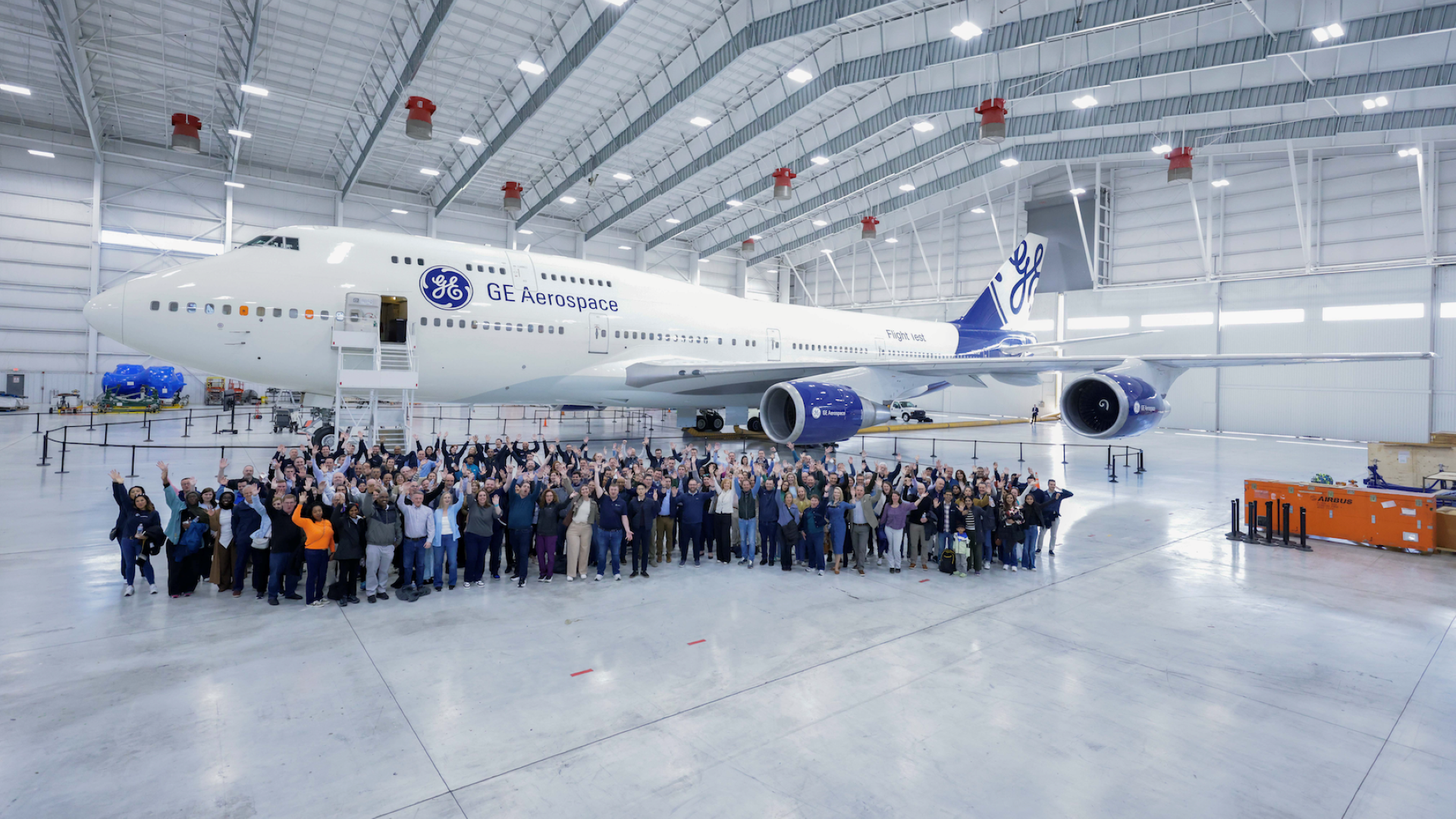
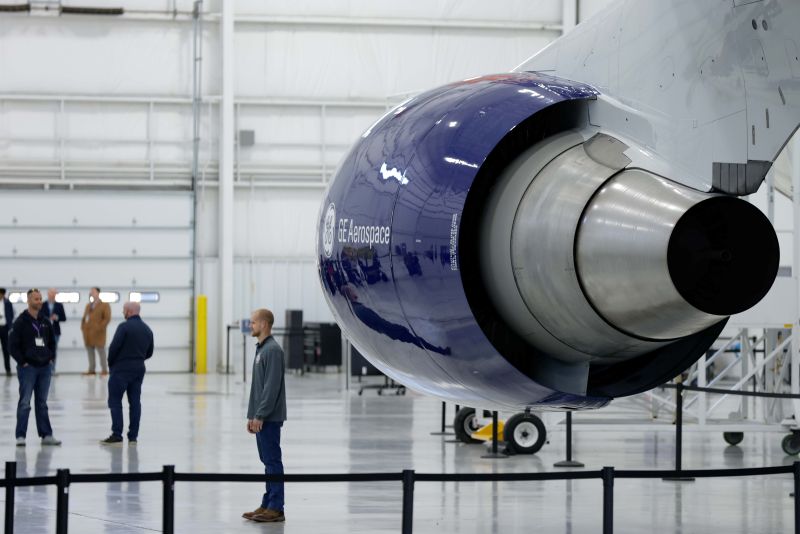
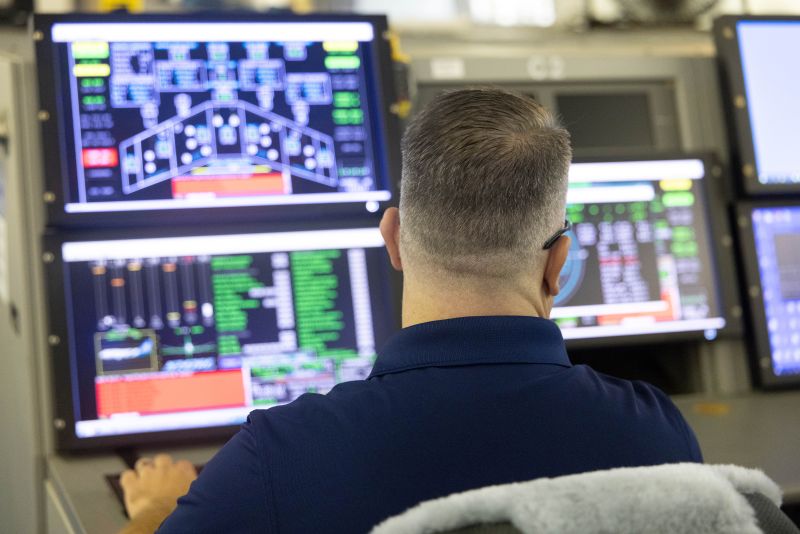
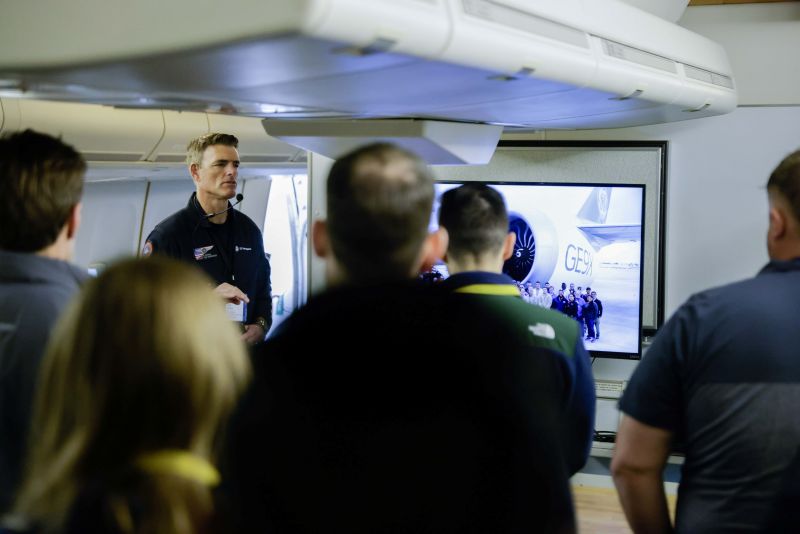
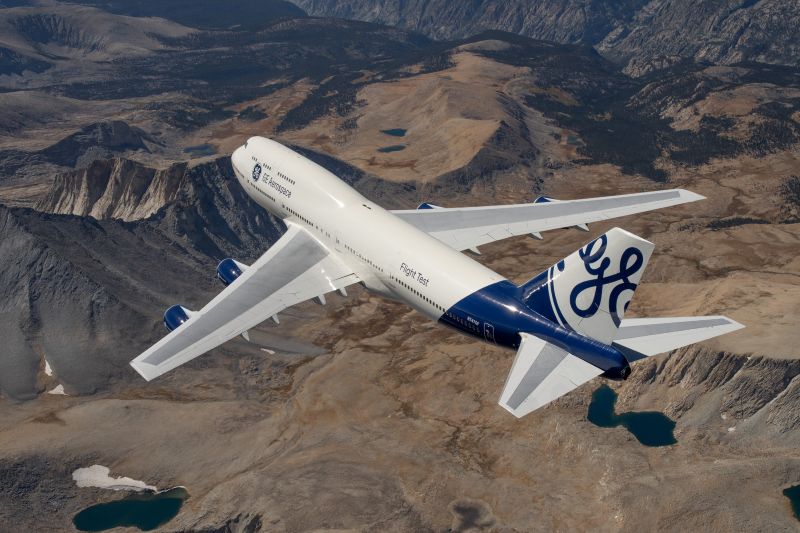
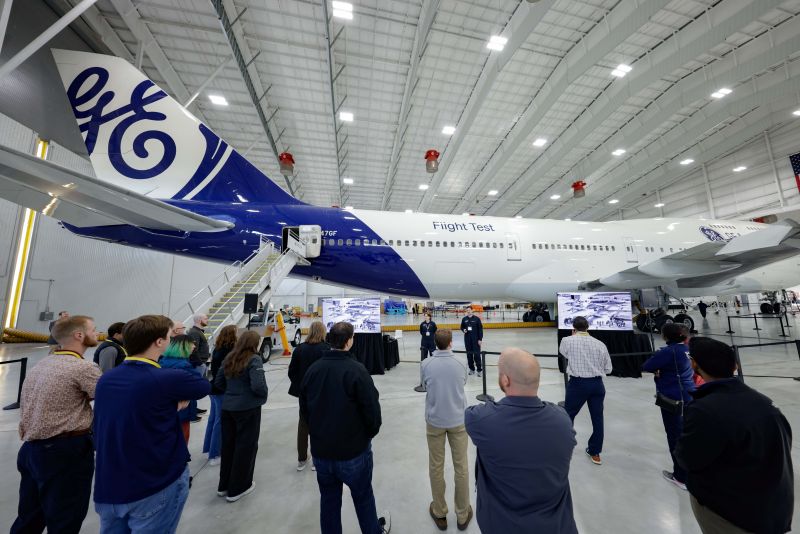
Some of the 1,300 GE Aerospace employees who took a tour of the Flying Test Bed during a recent visit to company headquarters in Cincinnati, Ohio. Images credit: GE Aerospace
Article
Touchdown Cincinnati! GE Aerospace’s 747 Flying Test Bed Visits HQ
A giant flying laboratory doesn’t pay a visit to your local airport every day. But in early April, one landed at Cincinnati/Northern Kentucky International Airport (CVG), and GE Aerospace employees were lucky enough to get a guided tour.
The airborne laboratory in question is the GE Aerospace 747 Flying Test Bed, which usually operates out of the company’s Flight Test Operations (FTO) center in Victorville, California, on the edge of the Mojave Desert. To celebrate GE Aerospace’s second anniversary as a standalone company, the Flying Test Bed flew east to the company’s headquarters in Cincinnati and took up residence inside a 100,000 square-foot hangar at CVG. On April 7 and 8, 1,300 GE Aerospace employees were able to view and learn more about the inner workings of the plane that is so integral to the company’s engine testing and technology advancement process. The visit ended on April 9 with the crew conducting a low-altitude flight over the Evendale campus.
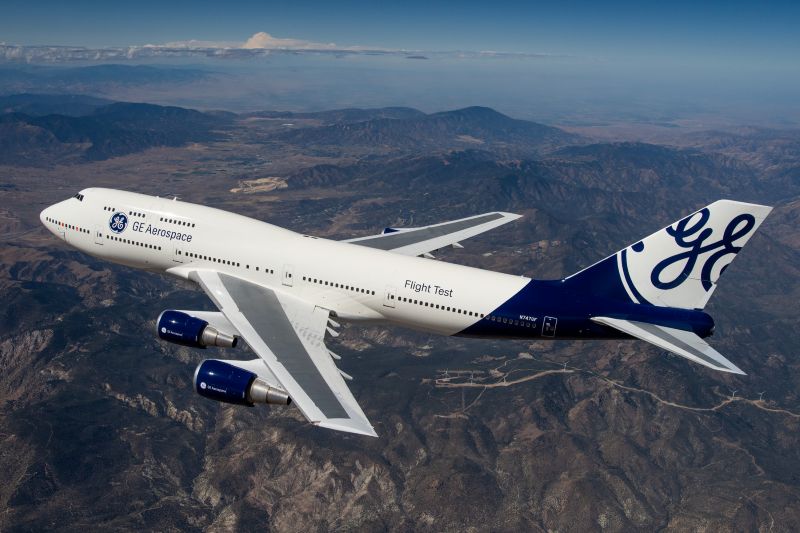
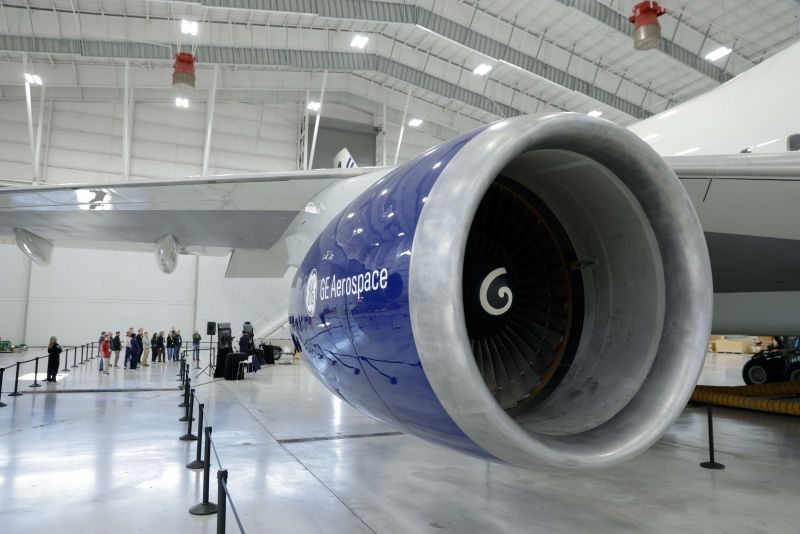
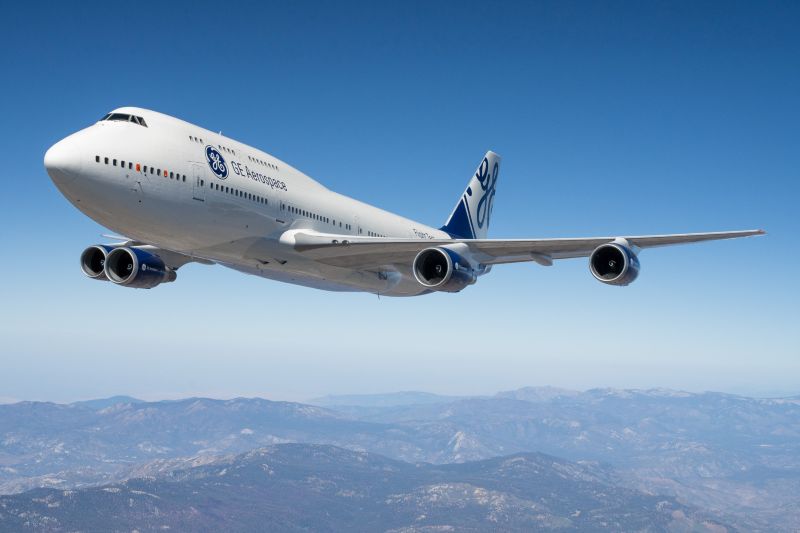
Here are a few photos showing the Flying Test Bed in flight, at its home base in Victorville, and during its brief touchdown in Cincinnati.
One of the first things GE Aerospace team members undoubtedly noticed is the Flying Test Bed’s new livery design. The current plane, a Boeing 747-400 previously operated by Japan Airlines, was acquired in 2010. When GE Aerospace became an independent, publicly traded company two years ago, it launched a refresh of its iconic brand, and the FTO team took that opportunity to update the plane’s appearance as well. The new livery features a pristine white fuselage bisected diagonally to cover the tail in a striking shade of “Atmosphere Blue,” with the GE Monogram trademark showcased on the rudder. “Everyone [at FTO] is really energized by the new look,” says Chief Test Pilot Jon Ohman.
Before an engine can be certified for commercial use by the FAA, it must undergo rigorous testing in real-world conditions — meaning, attached to the wing of a plane, rather than inside the controlled environment of an earthbound test cell. This is what keeps the team members at FTO busy working with engineering and design teams throughout GE Aerospace. The company operated a 747-100, previously owned by Pan Am, as a Flying Test Bed for 24 years before retiring it to the Pima Air & Space Museum in Tucson, Arizona, in 2018. Combined, the two 747s have certified 12 different engine models and multiple variants, including the GE90, CFM56-7B, CF34-8C and -10E, GP7200,* GEnx-1B and -2B, LEAP-1A, -1B, and -1C,** Passport, and GE9X.
While most testing takes place well before an engine is certified, additional tests are sometimes required if issues crop up in the field after an engine has entered service. Testing runs the gamut from basic performance adjustments, including fuel burn, to extreme flight conditions, such as stalls and air starts, zero-gravity operations, large sideslips, and sustained flight in icy conditions. Since 2010, the 747-400 has logged more than 1,500 hours in the air dedicated to advancing engine technology.
Testing requires patience and the ability to make adjustments literally on the fly. This can often be the case with air starts — which require restarting an engine while in flight, in a variety of scenarios involving different speeds and altitudes. On occasion, the FTO team will run a test with the expectation that the engine will perform a certain way, only to discover different behavior. “There’s two ways to look at that,” says Principal Flight Test Engineer Nate Kamps. “One is, well, the engine didn’t behave the way we thought it would. On the other hand, that’s why we run the tests. Those findings are valuable. That’s the work we need to do to certify our commercial products.”
It can take the FTO team months to prep for an engine test. In addition to the regularly scheduled maintenance of the 747-400 itself, the team often has a long to-do list: software upgrades, regular upkeep of the electrical power systems, installing a specialized pylon (the device that attaches the engine to the wing) for each test campaign, connecting all of the instrumentation inside the test engine to the onboard computers for monitoring and data collection, planning the tests, and structuring what the flights will look like.
On flight test days, the Flying Test Bed can get a little crowded. The test director sits with the two pilots in the cockpit on the flight deck — the upper deck of the jet, inside the 747’s famous hump. The rest of the test team takes up position on the main deck, where most of the coach class seats have been removed to make room for racks of computers and individual workstations. There can be anywhere from eight to 20 people on board a typical flight. Only one forward galley remains (the rest were removed to make room for the computer equipment), along with a couple of lavatories. “Most of our flights are on the order of six to seven hours,” says Senior Engineer Kevin Murtha, who manages much of the scheduling, hardware, and instrumentation needs for each test. “That would make for a very long day if you didn’t have access to the lavs on board.”
The Flying Test Bed’s already busy schedule will be getting even busier over the next decade. A major testing campaign on the horizon is the much anticipated CFM RISE program,*** a suite of demonstrator technologies aimed at producing at least a 20% improvement in fuel efficiency compared with today’s commercial engines, as well as improved durability. One such technology is the Open Fan engine design, which sheds the traditional ducts encasing the engine for improved efficiency with less drag. “The RISE program is going to be an exciting opportunity for the team here in Victorville,” says Ohman, who can be seen wearing a headset in the photo above. “The Open Fan catches your eye, but what we’re really after is the performance data. This plane is more like a laboratory than anything else, and all that data ensures that the advanced technology in the engine is working as expected to meet the goal of that step change in fuel efficiency and durability.”
The test flights the 747-400 undertakes not only support the development of robust and reliable products but also enable the evaluation of emerging technologies, providing valuable data that sparks innovation. In 2024, GE Aerospace conducted a series of test flights for the Contrail Optical Depth Experiment (CODEX) project with NASA, in which they studied contrail formation — the ribbons of ice that form when jets fly through cold, humid air. The CODEX tests aimed to deepen the aviation industry’s understanding of emissions and help establish a baseline for future engine testing in the RISE program.
During its trip to Cincinnati, the Flying Test Bed was powered by four CF6 engines. But during a test flight, one of those CF6 engines is replaced by the test engine. Having three additional CF6 engines on wing during a test, says Kamps, “means three other sources of electrical power, three other sources of thrust, three other sources to drive the hydraulic systems. There’s lots and lots of redundancy.” The 747 also has a very large tail with a powerful rudder that can help correct any asymmetric thrust, such as when a GE9X engine exerts more thrust than the CF6 engine on the opposite wing, causing the plane’s nose to yaw to one side. Finally, the Flying Test Bed has a very big flight envelope of airspeed and altitude capability. “It can go very fast and very high for a commercial airplane,” says Kamps, which enables the FTO team to put GE Aerospace engines through such a wide variety of arduous tests.
* The GP7200 is manufactured by the Engine Alliance, a 50-50 joint company between GE Aerospace and Pratt & Whitney.
** LEAP engines are produced by CFM International, a 50-50 joint company between GE Aerospace and Safran Aircraft Engines.
*** RISE is a technology development program from CFM International. It is not a product offered for commercial sale.
See other posts
GE Aerospace is a world-leading provider of jet and turboprop engines, as well as integrated systems for commercial, military, business and general aviation aircraft.