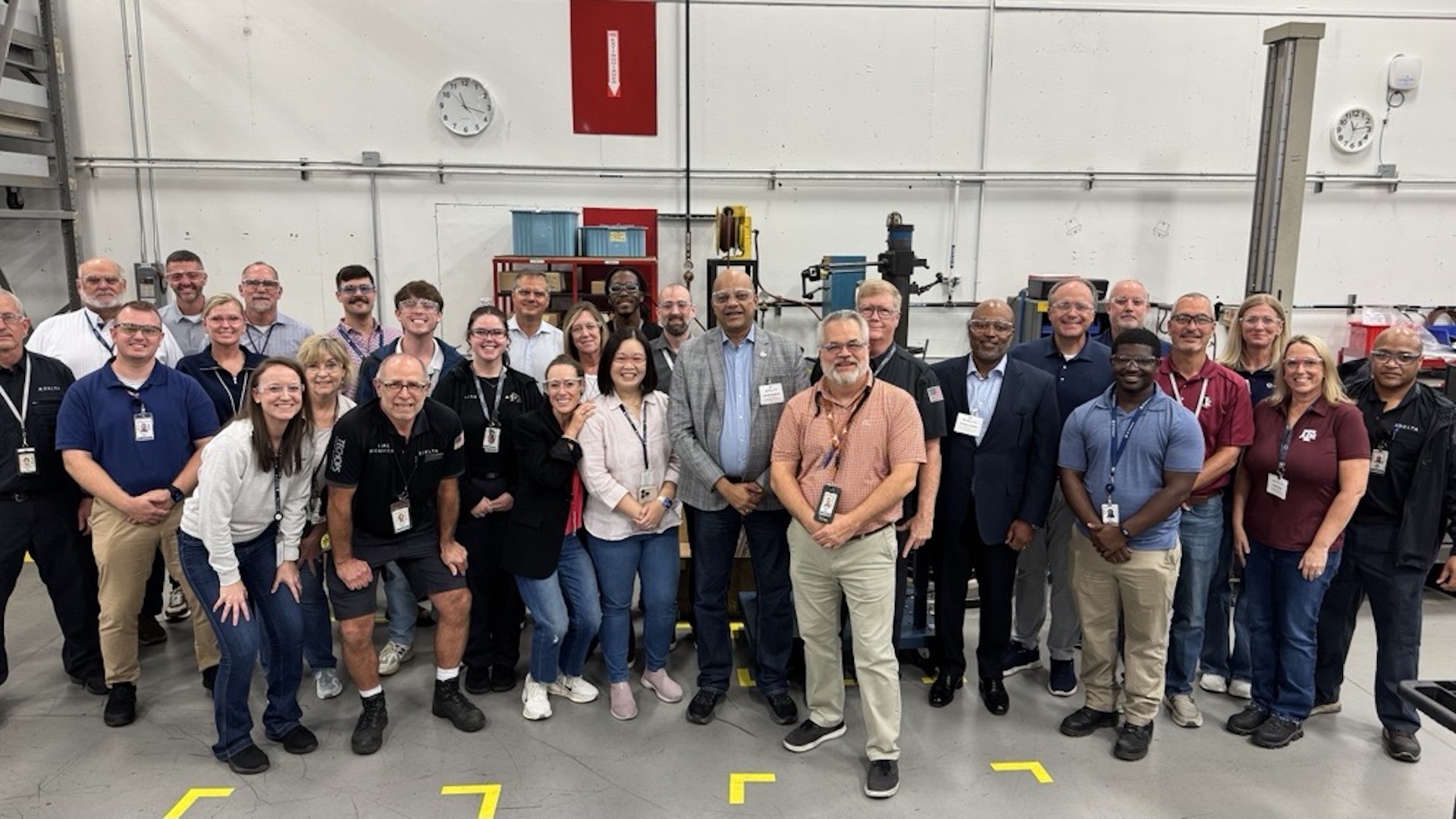
Team members from GE Aerospace and Delta TechOps during a recent kaizen event at one of Delta Air Lines' MRO facilities. Image credit: GE Aerospace
Article
Building Muscle Together: How GE Aerospace and Delta Air Lines are Using FLIGHT DECK to Enhance Delta TechOps’s CF6 Engine Maintenance
April 28, 2026 | by Chris Norris
In May 2025, a GE Aerospace team visited Delta Air Lines’ headquarters in Atlanta to align with Delta TechOps, the airline’s maintenance, repair, and overhaul (MRO) provider. Their mission was to explore how to apply FLIGHT DECK, GE Aerospace’s proprietary lean operating model, alongside Delta TechOps’ existing maintenance disciplines on the CF6 engine maintenance line.
Given that roughly 25% of Delta’s widebody fleet is powered by CF6 engines, both teams saw an opportunity to accelerate performance through a shared focus on seamless, uninterrupted flow, improved cycle time, and standard work. Ultimately, they laid out an ambitious goal: over the next 18 months, GE Aerospace and Delta TechOps would conduct eight kaizen events with the aim of reducing Delta’s turnaround time (TAT) by 34%.
The first kaizen event took place in September 2025 in Atlanta. In lean parlance, kaizen means “continuous improvement” and an event consists of an intensive group activity over multiple days to scrutinize and improve processes. In this case, the event concentrated on the CF6 rotor disassembly and assembly process and was attended by four team members from GE Aerospace and a cross-functional team of 12 from Delta. The combined group focused on the Delta TechOps team’s process of dismantling, overhauling or replacing, and reassembling a CF6 engine’s rotating components. The kaizen event delivered strong, measurable performance improvements.
“Delta uncovered the opportunity to develop and deploy standard work,” reports Brette Smith, executive FLIGHT DECK leader for manufacturing and business process improvements at GE Aerospace. “We spent time at genba” — that is, visiting and studying the place where the work happens — “capturing time measurements together. We watched the operation, seeing how long the phases took and noting barriers technicians were experiencing.”
The team zeroed in on takt time, which refers to the rate at which a repaired engine needs to be finished to meet customer demand, and determined that the Delta TechOps team’s prevailing cycle time was exceeding takt.
“Going to genba enabled the Delta TechOps managers to learn directly from their technicians about the complexity of the tooling they were using and where it needed to be stored,” says Smith.
Reinforcing a Continuous Improvement Mindset
While FLIGHT DECK journeys like Delta’s are highly data-driven, they can also reveal powerful insights that inform new practices.
During the kaizen, the team evaluated two approaches to rotor reassembly — one traditionally used by more tenured technicians (horizontal assembly) and another favored for its ergonomic advantages (vertical). Through time studies and ergonomic assessments, the data reinforced that vertical assembly improved safety, quality, delivery, and cost, or SQDC.
“Through looking at time measurements and ergonomics assessment, everyone discovered that vertical is actually best in terms of SQDC,” says Smith.
This shift in perspective speaks to the practical breakthroughs that teams experience through a commitment to continuous improvement.
“You don’t have to convince someone to do things differently,” Smith says. “Ideally, you create the environment where they discover what is possible and meets the needs of their employees and customers.”
The first kaizen delivered immediate, measurable results, including a shift in ergonomic risk from high to low, a 54% reduction in cycle time, and a 34% reduction in technician travel.
Delta TechOps is known for its ability to adapt swiftly to operational challenges. FLIGHT DECK added a structured framework that complements that responsiveness by pushing deeper into root‑cause problem solving.
“Delta TechOps has long-established and disciplined continuous improvement practices and a strong track record of operational execution,” says Jack Lysinger, managing director of Delta TechOps Strategy and Business Performance. “As those fundamentals remain essential, FLIGHT DECK builds on this foundation by providing a common, enterprise-level framework to more consistently identify root cause, reinforce standard work, and scale improvements across the organization. It strengthens the continuous improvement culture that already exists within our frontline teams and leadership.”
Trusting the Process and Scaling Up
The second kaizen event, held in November, focused on CF6 engine assembly. Here, insights from GE Aerospace’s global network — including visual management practices observed at the company’s site in Celma, Brazil — helped further streamline installation processes and eliminate defects.
In fact, this was one of many ideas Delta TechOps gleaned from the Celma site, which they had visited shortly after completing their initial value stream analysis session with GE Aerospace. During that visit, the TechOps team was impressed by the Celma team’s ability to leverage a smaller physical footprint in the facility to overhaul and repair CF6 engines, as well as the alignment of operations to takt time and the technicians’ use of visual management to spot abnormalities quickly and tackle their root cause. Delta TechOps also paid a visit to GE Aerospace’s site at McAllen, Texas, which Lysinger says provided valuable benchmarking insights and reinforced practices Delta TechOps could adapt at scale.
“Like most high-performing, complex operations, we’re very good at moving from issue to solution,” says Lysinger. “What lean methodology reinforces is the value of letting the process and the data surface the true constraints first. And then, value stream mapping helps keep the focus where it belongs — with our technicians — so improvements are grounded in the work itself and allow us to close gaps in a sustainable way.”
By the end of the second kaizen event, engine assembly defects had been eliminated, alongside meaningful gains in efficiency, including a 24% reduction in cycle time and a 45% reduction in technician travel.
The kaizen journey has further strengthened Delta TechOps’ focus on continuous improvement. After seeing it in action, teams are already looking ahead to where these methods can be applied next.
The transformation road map drawn up at that initial meeting last spring still has a lot of to-do’s to be tackled over six more kaizen events in the coming year. Ultimately, the goal is to reduce Delta’s CF6 MRO turnaround time by 34% by the end of 2026. (To date, they have shown an improved and consistent reduction of TAT by 25%.)
“The temptation is often to tackle the largest challenges first, but lasting results come from building the right foundations — leadership alignment, standard work, and consistent problem solving — so teams are equipped to address more complex issues over time,” says Smith.
This is why Delta TechOps is taking a deliberate, holistic approach to applying FLIGHT DECK principles, building on existing operating disciplines to support sustainable improvement as methods scale across TechOps.
As Lysinger explains, “One important lesson that resonated with us in working with Larry Culp and the GE Aerospace team is the emphasis on building from a strong foundation. That means leadership alignment, clarity, and consistency in how we operate — all of which are essential as we scale continuous improvement across TechOps.”
See other posts
GE Aerospace is a world-leading provider of jet and turboprop engines, as well as integrated systems for commercial, military, business and general aviation aircraft.