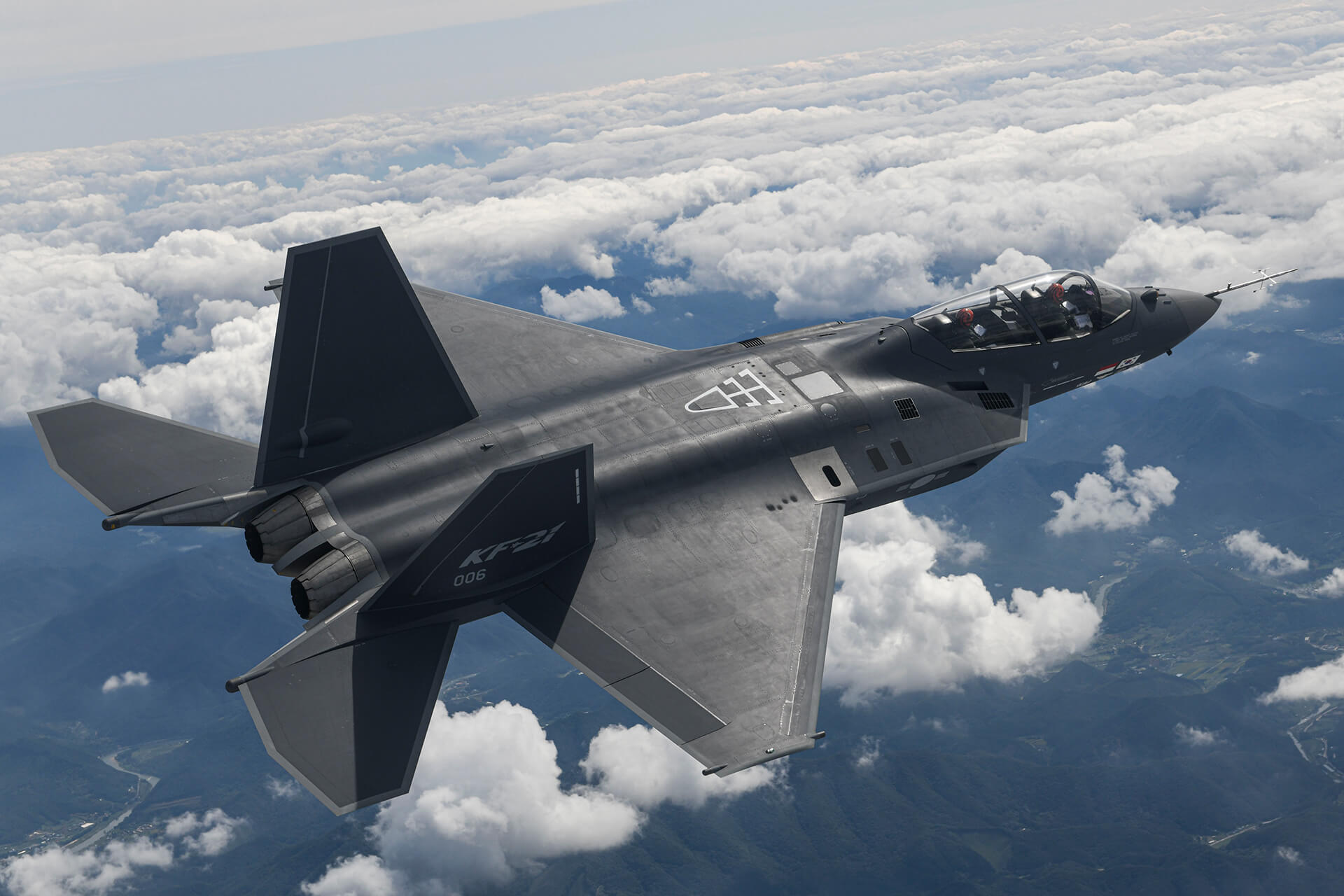
Image credit: Ministry of National Defense of the Republic of Korea
Article
KF-21 Takes Off: The Power Behind Korea’s Next-Gen Fighter
July 15, 2026 | by GE Aerospace Staff
March 25, 2026, marked a defining milestone for the Republic of Korea’s aerospace sector when the first mass-produced KF-21 Boramae was unveiled at a rollout ceremony attended by President Lee Jae Myung. In the months since, full-scale manufacturing has ramped up, marking the program’s transition from development into operational deployment.
Debuting a new fighter jet was also a “coming of age” moment for the local industry, notably in its capability to produce advanced military aircraft. KF-21’s arrival comes after years of planning, action, and effort to significantly boost indigenous aerospace capability, national defense readiness, and Korea’s role in the global aerospace sector.
Years in the making, the KF-21 program reflects Korea’s commitment to strengthening indigenous defense capabilities while building a globally competitive aerospace ecosystem. It is also a testament to the power of collaboration – bringing together local expertise from Korea Aerospace Industries (KAI) and Hanwha Aerospace with proven global technologies.
“The KF-21 program represents an important step forward for Korea’s aerospace industry, not only in aircraft development but in strengthening our capabilities across the value chain. It is not every day we celebrate the arrival of a state-of-the-art fighter jet that was initiated, designed, developed, and built in Korea with support from expert partners around the world,” said Sun Kim, Executive Vice President and CEO of Hanwha Aerospace’s Aero Engine Business Group. “Working closely with global partners like GE Aerospace, we are advancing our ability to assemble and support advanced propulsion systems locally – an important foundation as we continue to build a more capable and competitive aerospace ecosystem in Korea.”
Behind The Capability
As Korea continues to build its aerospace capabilities, propulsion remains fundamental to what the KF-21 can achieve in operation. Under its wings, GE Aerospace’s F414 engine provides the power and responsiveness that enable the aircraft’s mission capability.
The F414 engine delivers approximately 22,000 pounds (98 kN) of thrust, placing it in a high thrust-to-weight class that enables a faster response under demanding flight conditions, such as steep climbs and fast turns. These characteristics are essential for modern combat scenarios, where responsiveness and control can define mission success.
Designed for rapid throttle transitions with zero throttle restrictions , F414 allows pilots to respond quickly to dynamic conditions in flight. This responsiveness, combined with its thrust output, contributes directly to the KF-21’s operational effectiveness – including an extended combat radius and a longer lifespan than that of current aircraft.
The engine builds on the proven architecture of the F404, while incorporating significant advancements that increase thrust by up to 35% . Just as importantly, it is engineered for durability and maintainability, supporting sustained performance over long operational cycles.
The Engine Of Choice
Since entering service in the late 1990s, more than 1,600 engines have been delivered globally, accumulating millions of flight hours across a wide range of missions and environments. This track record provides a high level of confidence in the engine’s reliability and consistency – critical factors as the KF-21 program transitions into mass production and long-term service.
The F414’s adoption across multiple advanced fighter platforms also demonstrates its adaptability. For Korea, this means the KF-21 is powered by an engine that is not only capable but also proven in real-world operations, helping reduce development risk while supporting readiness from day one.
Before the KF-21, the F414 is selected to power a range of advanced, next-generation fighter aircraft, including the Boeing F/A-18E/F Super Hornet, E/A-18G Growler, and Saab JAS 39E/F Gripen NG, NASA X-59 QueSST.
Advanced Materials Driving Innovations
Developing and employing advanced materials is another approach GE Aerospace uses to bolster propulsion.
Ceramic matrix composites (CMCs), often referred to as “super materials,” make a major difference because they can withstand significantly higher temperatures than traditional metal alloys. They are one-third the weight of metal counterparts and possess great heat resistance, withstanding up to 500 degrees more heat with durability. These “super qualities” help to create more efficient, durable jet engines.
GE Aerospace has demonstrated the use of these materials by operating rotating CMC components in an F414 engine. These components successfully completed 1,000 test cycles, validating their ability to withstand the extreme, high-pressure environment inside a high-performance military engine.
A Foundation For Future Growth
As the KF-21 enters mass production, the F414 engine, with its proven performance reputation built over decades of operational experience, is primed to support this important stage of development and future ones.
By 2032, GE Aerospace is expected to provide 240 F414 engines, along with additional spare engines, supporting the long-term operation of the KF-21 program for the Republic of Korea Air Force.
Looking ahead, the F414 platform also provides a pathway for future capability enhancements. Drawing on GE Aerospace’s experience and ongoing technology development, upgrade options can be tailored to evolving operational requirements of the KF-21 – offering a practical approach to enhancing performance while managing cost and minimizing integration risk for the Republic of Korea Air Force.
“The F414 engine is a critical enabler of the KF-21’s performance, delivering the thrust, responsiveness, and reliability required for next-generation operations,” said Youngje Kim, GE Aerospace’s General Manager of Asia Pacific Defense & Systems. “Beyond supplying the engine, we are actively supporting local assembly in Korea through the provision of engine kits, alongside training and close collaboration with Hanwha Aerospace. This approach helps build in-country capability while ensuring the consistency and performance the program depends on.”
This builds on GE Aerospace’s long-standing presence in Korea, including its role in powering the T-50 Golden Eagle with the F404 engine , and reflects an ongoing approach centered on collaboration, reliability, and shared progress.
The KF-21 program is not only a technological milestone but also a foundation for future growth. Through proven propulsion systems, continued innovation, and close industry collaboration, GE Aerospace remains committed to supporting Korea’s journey as it advances its position in the global aerospace landscape.
See other posts
GE Aerospace is a world-leading provider of jet and turboprop engines, as well as integrated systems for commercial, military, business and general aviation aircraft.