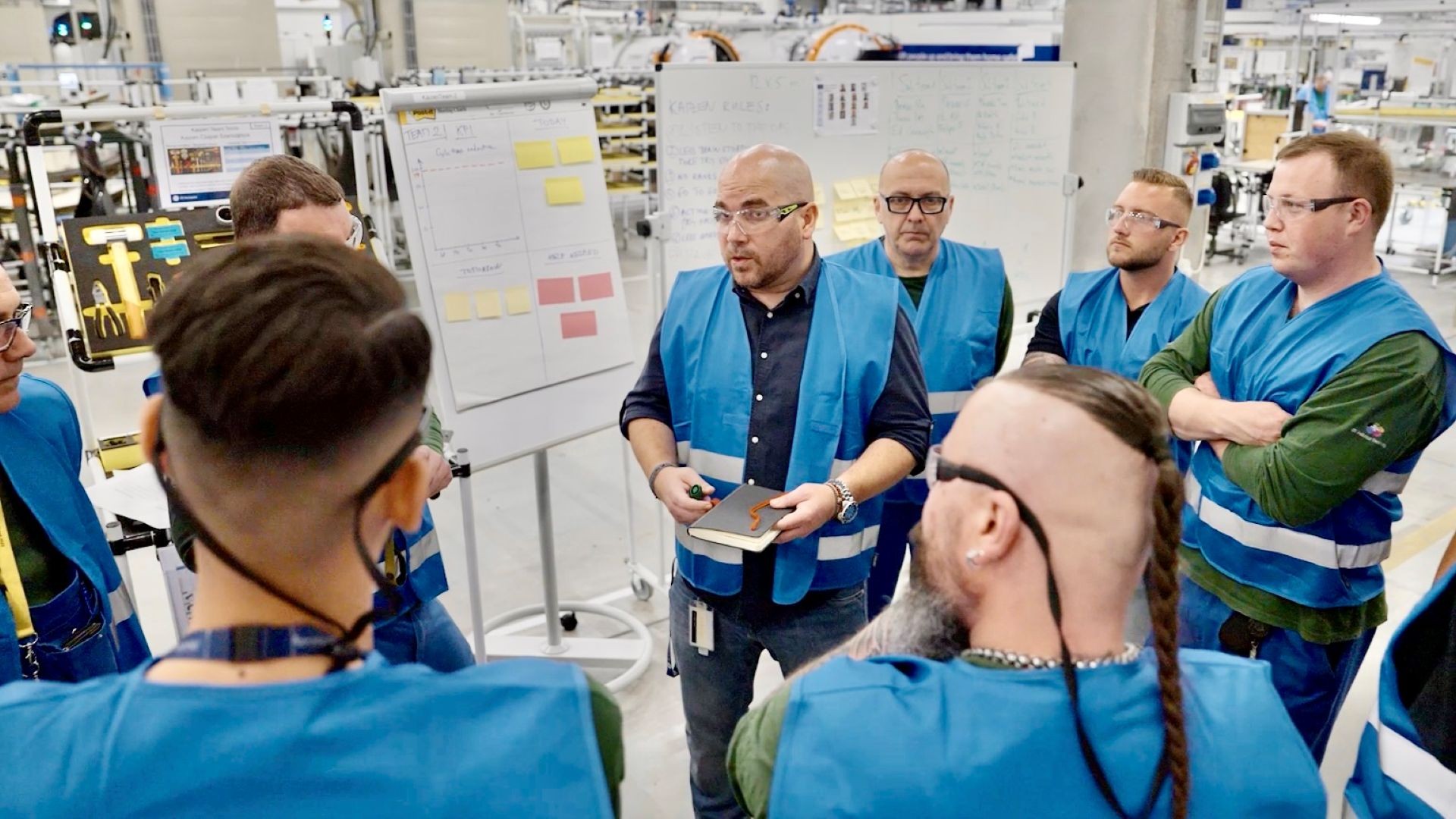
Last year, nearly 120 people participated in a shingijutsu kaizen event at GE Aerospace's component repair facility in Budapest to streamline every step of production. Image credit: GE Aerospace
Article
Blade Runners: FLIGHT DECK Fundamentals Deliver Big Gains in Hungary
October 29, 2026 | by Chris Norris
In early 2025, employees at GE Aerospace’s component repair facility just outside Budapest, Hungary, determined that two of the plant’s autoclave machines — the high-temperature, high-pressure units that cure and treat materials for composite engine parts — needed to be reworked to ensure peak performance. The facility repairs fan blades for the CFM LEAP,* GEnx, and GE90 engine programs. To update its autoclave equipment and implement additional process improvements across teams and functions, the site underwent a temporary production pause. “As a critical link in the Maintenance, Technology, and Operations network, we needed to resolve these issues and begin delivering to our customers quickly,” says Tim McQueen, repair general manager for GE Aerospace.
By April of that year, the work stop had produced a significant backlog at the plant. “The work in progress at the site had nearly doubled, which would result in extended lead times and a long recovery,” says McQueen. It also disrupted operations on the shop floor. “Overall, it was quite hard for us,” says Daniel Andor, a process engineering support specialist.
The team ultimately used this disruption as an opportunity to transform the component repair shop through steady application of FLIGHT DECK, GE Aerospace’s proprietary lean operating model. “Our goal was to develop a plan to meet customer needs while burning down the backlog we had developed. We needed to ensure we kept safety and quality at the forefront, as always, and that we used the momentum we created to transform the way we worked,” says McQueen.
A New Logical Flow
That May, nearly 120 people participated in a shingijutsu kaizen event at the Hungary plant focused on LEAP engine fan blades. During the event, the team established targets to improve shop yield and performance. (Shingijutsu means “new technique.”)
To help meet customer demand while reducing the backlog, the team needed to increase the composite cell’s parts output by more than 200% per week — equivalent to raising the plant’s average blade repair rate by 33% per week.
They began by strengthening daily and visual management on the shop floor. Managers sought ways to reduce rework on LEAP engine fan blades, reviewing the entire repair process to identify and address technical issues at each step.
Operators like Andor were instrumental in this process — identifying safety and ergonomic opportunities, bottlenecks, and other areas of waste. “Two issues were LEAP engine paint repair and polyurethane paste repair of the blades,” says Andor, referring, respectively, to the substances used to restore protective surface coatings and rebuild or level worn areas. Issues related to the poly paste repair process created daily rework. “So we shifted final painting and labeling from an external supplier to our own in-house operation. Keeping the parts on-site allowed us to use one-piece flow, helping to increase shipment volume.”
Another opportunity uncovered during the kaizen event: Given the layout inside the 117,000-square-foot facility, “moving from one workstation to another could take hundreds or even thousands of steps,” says Andor. Using FLIGHT DECK fundamentals, the team redesigned the floor plan so that related stations sat next to one another — “all in sequence of the work,” Andor says. Cutting those extra steps reduced wasted motion, improved the flow of parts through the shop, and helped the operation run more efficiently. “We introduced a new logical flow to the entire repair operation.”
The team also created a new U-shaped table to reduce motion in preparing repair materials for the composite parts; removed potential tripping hazards; and introduced new clamping mechanisms and protective foam to help reduce risk when handling LEAP engine fan blade parts. “We standardized the painting process, combined steps, and introduced new workstations to enable these major process changes,” Andor says.
Using FLIGHT DECK to Improve the Process — and Team Spirit
Ultimately, the team in Hungary wound up reducing the time needed to transport parts through the shop in the LEAP engine fan blade cell by a striking 90% — in some cases cutting travel distances from a few thousand meters to a few hundred. Intuitive adjustments like that led to other changes down the line, resulting in a 32.4% reduction in cycle time (the span of time from the moment the repair process begins to when a blade is fully finished).
“We demonstrated that we could improve LEAP fan blade deliveries by 67%,” McQueen explains. “But due to the variation of different programs on the blade line, we adopted a more consistent productivity measure that calculates the number of parts each operator completes per shift on average. Since this change we have seen the output improve by 31%.”
Such improvements build upon one another. Over the past 12 months, the Hungary facility has reduced rework on composite parts by 62.5% and cut in-process inventory for those parts by more than 50%. This progress has enabled the team to reduce the backlog by 75%. And they’re still improving: The team addressed additional safety opportunities and reduced the overall distance a blade traveled on its repair journey inside the plant by over 80%.
One additional metric reflects the site’s broader progress with FLIGHT DECK. Between May 2025 and May 2026, the Hungary site raised its employee engagement score for FLIGHT DECK by 30% — a testament to the transformation underway.
“For us, it was a continuous improvement journey,” says Andor. “At that first shingijutsu kaizen event, people felt that they could use FLIGHT DECK for unity, teamwork, a few process changes. Now they know just how big an improvement it can make in our lives.”
* CFM LEAP engines are products of CFM International, a 50-50 joint company between GE Aerospace and Safran Aircraft Engines.
See other posts
GE Aerospace is a world-leading provider of jet and turboprop engines, as well as integrated systems for commercial, military, business and general aviation aircraft.