Article
GE Aerospace’s Quick Six with Engineer Marta Wąsik
September 17, 2026 | by GE Aerospace Staff
From working parents to military veterans, GE Aerospace would not be the company it is today without its employees. We created “Quick Six” to celebrate our diverse talent by asking employees six questions that uncover the unique ways that they contribute to GE Aerospace and the world.
In our latest installment of Quick Six, GE Aerospace sat down with Marta Wąsik, an engineering leader at GE Aerospace in Poland, who has spent most of her career working across the CFM International* engine family. She joined GE Aerospace nearly 20 years ago as a reliability engineer for CFM56 engines. Her next role was more business-focused, developing cost and reliability models that helped customers maximize the value of their fleets. In recent years, in addition to her executive role, she has also led a technical project focused on improving the durability of CFM LEAP engines.
The CFM LEAP engine entered into service in August 2016. Your team is working on continuous improvements that will make it more efficient and reliable. What upgrades have already been introduced?
Within the LEAP program we are working on all project phases at the same time — field support, services, and continual upgrades. Our goal is to keep LEAP engines flying longer. In many cases, relatively small design changes can significantly improve component life and reduce maintenance requirements. We also work continuously to update serviceability limits in the engine shop manual. To give you an example, the Warsaw team worked on increasing fuel nozzle limits. We used our thermal lab in Warsaw to establish a limit for this complex process. This change allowed customers to fly longer without disruption.
Part of our regular work is also extending the life of life-limited parts (LLPs). These are parts working in the hottest section of the engine that need to be replaced after a specific number of flight cycles. During operation, we might learn from field data that the original cycle assumption was too conservative. My team works on providing engineering substantiation required to safely move components toward their ultimate life.
The LEAP engine is said to be maturing much faster than its predecessor, the CFM56 engine. What makes the LEAP engine so special?
I would say one word: experience. The LEAP program benefits from decades of learning from CFM56. We know which approaches were less effective in the past, allowing us to avoid repeating mistakes. Building on that, the LEAP engine incorporates technologies that simply didn’t exist when the CFM56 family was developed: advanced materials, additive manufacturing, sophisticated analytics, and modern design tools. These were developed as a response to known past challenges we are now able to address more effectively.
To give you an example, in just under 10 years of service, the LEAP engine passed 100 million engine flight hours. It took the CFM56 fleet 17 years to get to the same level of experience. This shows the unprecedented demand and ramp for LEAP engines. The combination of experience and new technology allows the LEAP program to mature at a much faster pace than previous generations of CFM engines.
How does your team’s work translate into broader impact across global aviation programs?
GE Aerospace is a global company. When you add to it the fact that CFM programs are delivered together with our partner Safran Aircraft Engines, you get the full scope of our international cooperation. Our engineers in Poland are working on multiple projects to support the LEAP program, which can influence decisions that affect aircraft flying all over the world.
From a hardware perspective, our strongest mark is in compressor and combustor technologies. Each GE Aerospace site works to a different extent across all engine modules. Our Polish team focuses on the specific functions of a compressor. That ownership allows us to implement required design changes faster.
In Poland, we also have a very strong analytics impact on our global operations. And when I say analysis, I mean stress, life, and thermal analysis across all skill sets. We have a great engineering team here providing analysis to all projects and all modules.
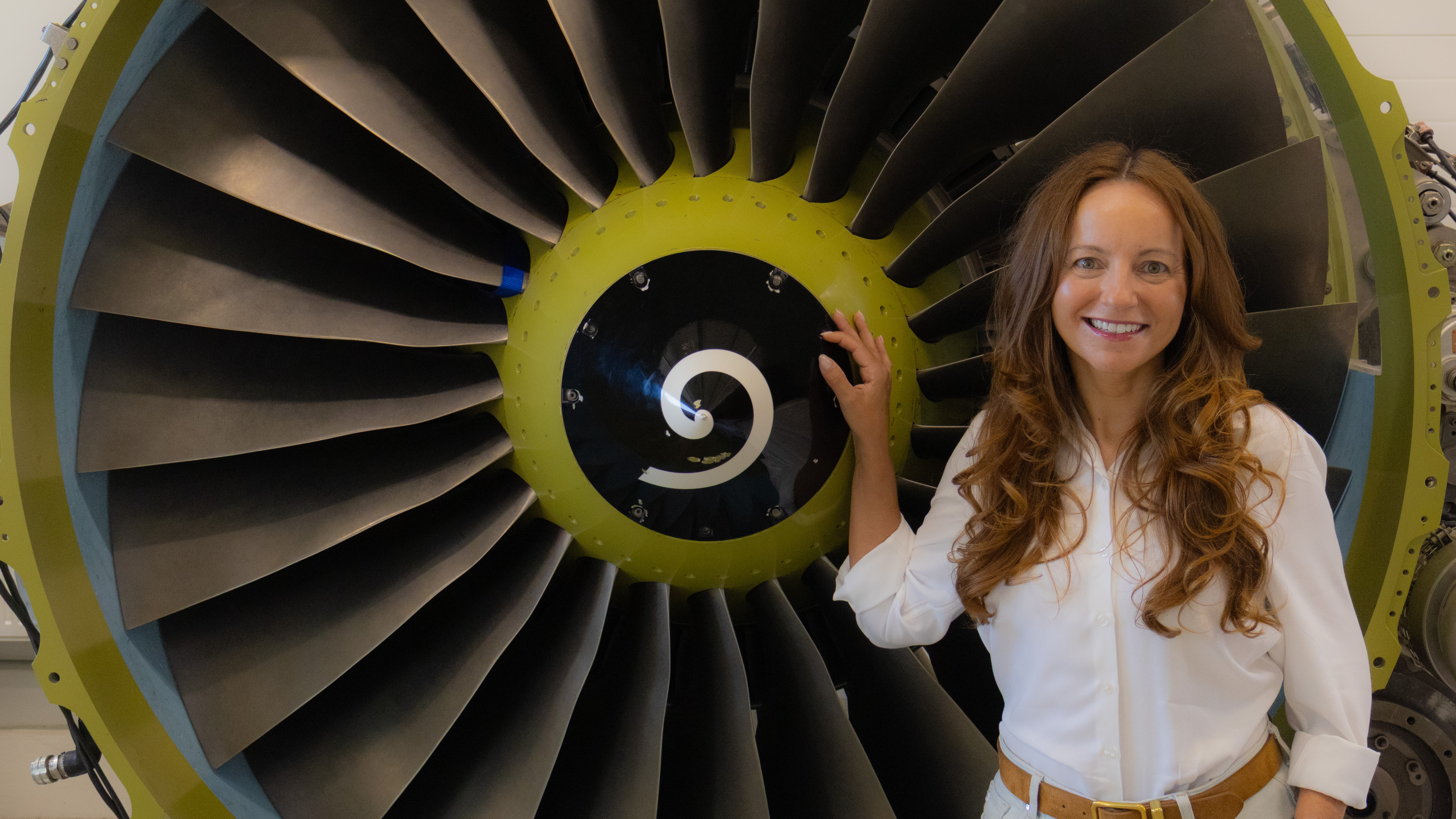
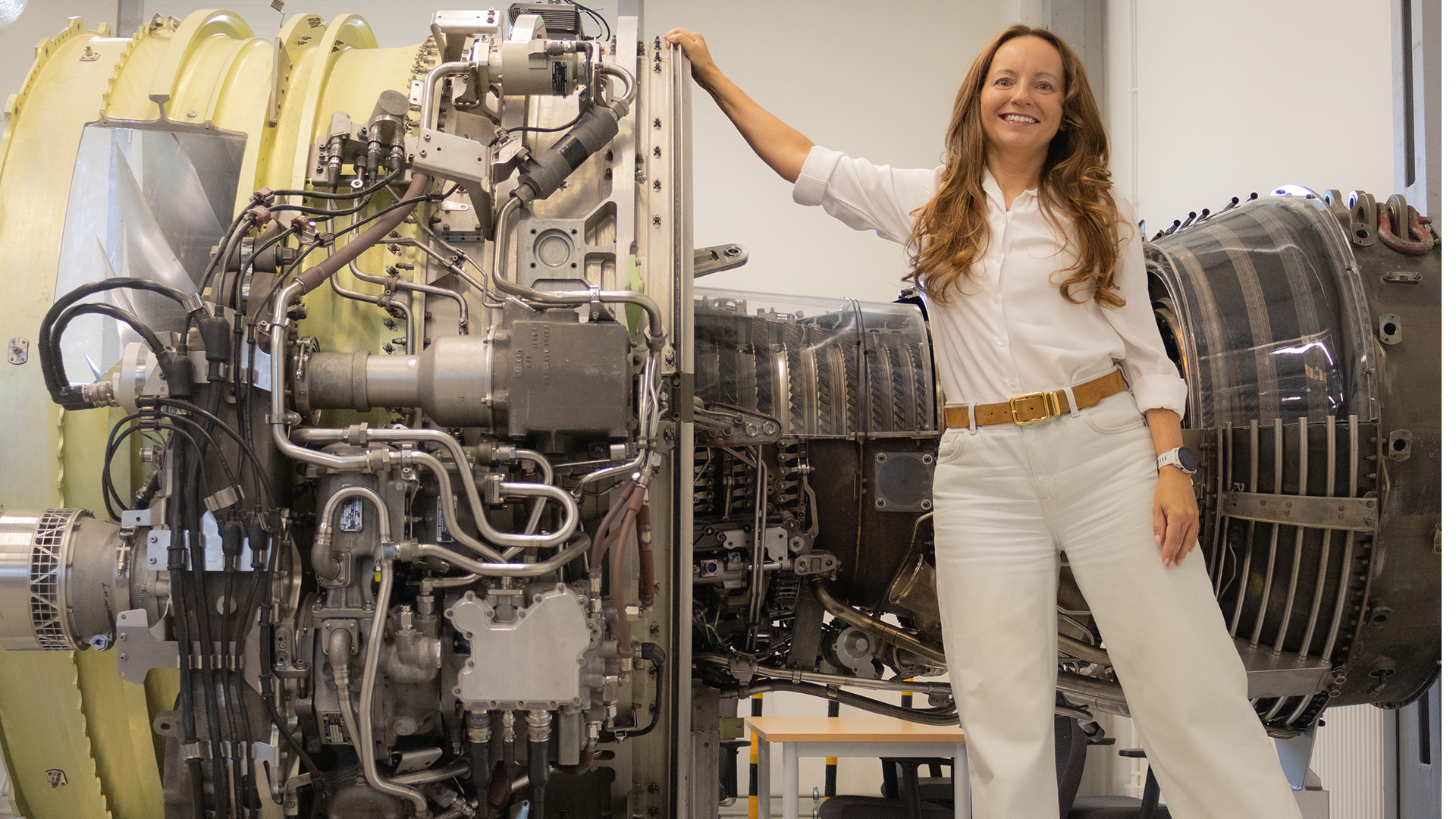
Marta Wąsik with a CFM56 engine
Beyond current hardware ownership, how is the team in Poland helping shape the future of flight?
Apart from engineering contributions like designing components and analytics, and modeling cost and reliability, it’s definitely AI development.
Using AI, our team wants to look further into the future. We are building capability that will allow us not only to improve existing processes, but also to reimagine them. Here we start with a whiteboard and ask whether what was developed 20 or 30 years ago is still the best way to approach a common problem — or whether we are ready to approach it differently.
What are you most proud of when you look at your team and what they’ve achieved?
That’s an easy question: It is the way we think about customers. Technical excellence is essential in aerospace. But the best engineers are the ones who understand the people behind the data and that their decisions affect airlines, crews, passengers, and communities around the world.
I often think back to my early years as a product support engineer. I remember a situation when I requested a combustor inspection when an aircraft had only minutes before the next departure. From an engineering perspective, it made perfect sense — I just needed the data. But what I failed to appreciate was the operational reality the customer was facing.
Today our team approaches problems differently. We still hold ourselves to the highest technical standards, but we also ask: What does success look like for the customer? I think engineers developing that mindset is what makes me the most proud. Technical skills build engines; understanding customers helps build the future.
Last question: What drives you every day?
Changing the world, of course! After more than 20 years in engineering, I have developed a personal mission: to repay the debt for everything I have received and to help build a world that did not exist yesterday, in which people can realize their dreams. At the same time, I believe that creating the future requires a commitment of continuous learning and the courage to embrace change.
Last November, I graduated from Harvard Business School, where I had the opportunity to exchange perspectives with senior leaders from around the world. That experience, along with many other learning opportunities throughout my career, has significantly broadened my perspective and evolved my way of thinking. It reinforced my belief that growth begins where certainty ends, and that staying curious, humble, and open to new ideas is essential for both personal and organizational success.
Every time I board an aircraft powered by our engines — and I do that several times each month — I am reminded of the level of expertise, commitment, and accountability behind every takeoff and landing. Knowing what goes into making those flights safe and reliable fills me with pride. My team and I are not simply building engines. We are helping people reunite with loved ones, pursue opportunities, explore new places, and create memories that last a lifetime. In a way, we are shaping a world where people can live their dreams … one flight at a time.
*CFM LEAP and CFM56 engines are produced by CFM International, a 50-50 joint company between GE Aerospace and Safran Aircraft Engines.
See other posts
GE Aerospace is a world-leading provider of jet and turboprop engines, as well as integrated systems for commercial, military, business and general aviation aircraft.