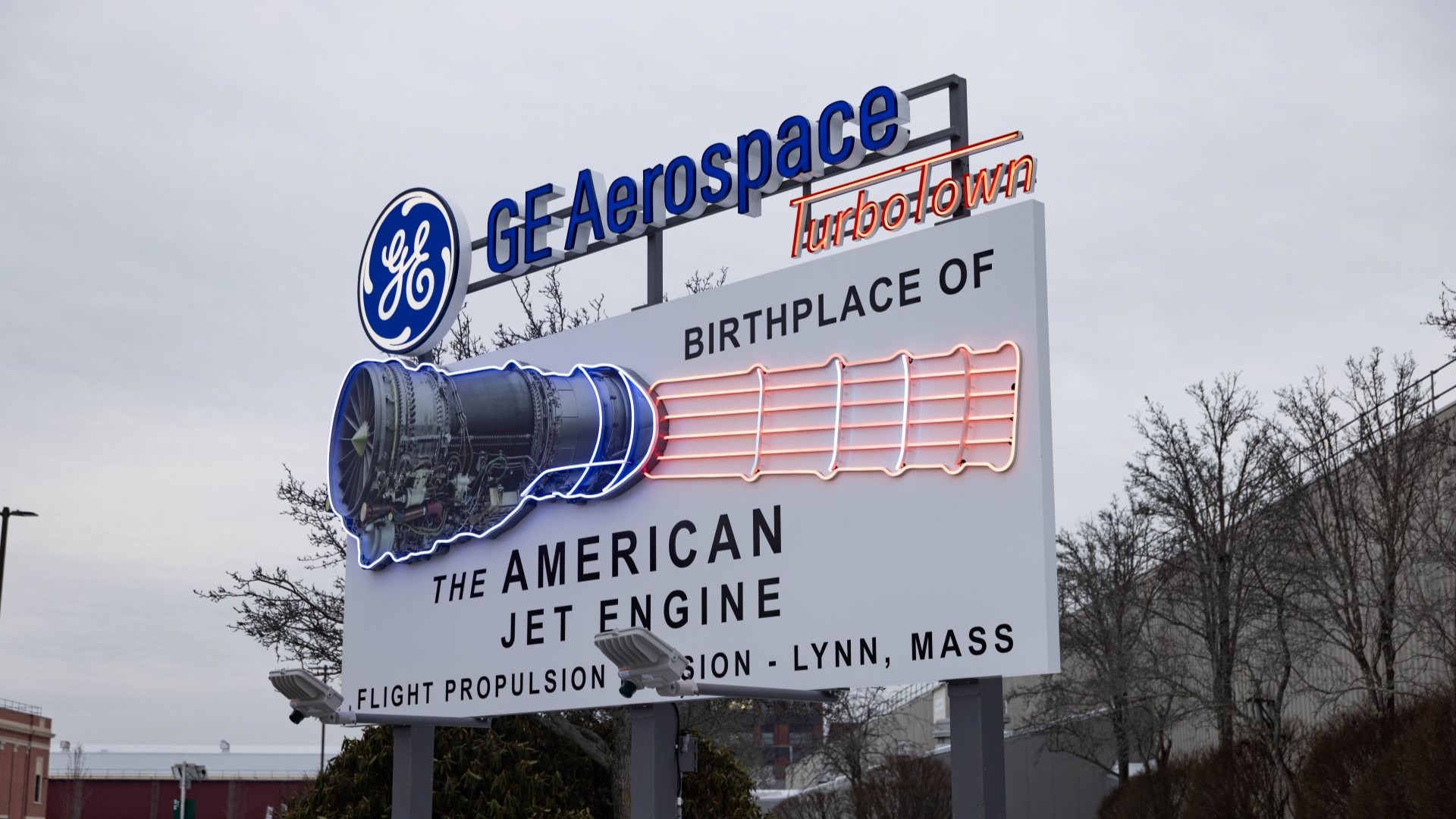
GE Aerospace’s new “Turbo Town” sign, in Lynn, Massachusetts, features an F414 engine, a modernized re-creation of the original 1964 sign’s J85 turbojet. Image credit: GE Aerospace
Article
Lights Up! Lynn Facility Taps into Its Jet Age History with Retro 'Turbo Town' Sign
April 1, 2026 | by Chris Norris
It was a retro-cool artifact, all sleek lines and space-age gleam. The neon-lettered “Turbo Town” sign was installed at GE Aerospace’s site in Lynn, Massachusetts, in 1964, with an illuminated replica of a J85 turbojet thrusting through the declaration “Birthplace of the American Jet Engine.” The nickname Turbo Town also speaks to the site’s more enduring legacy, forged when it produced the I-A, America’s first jet engine, in 1942.
So when Site Leader John McCarron found an archival photo of the old Turbo Town sign, which was taken down sometime in the 1980s, he knew what he had to do. “It felt important to take a pause and pay homage to what we do here,” he says.
“John brought us a picture of the old sign and said, ‘What would it take to reinvent this?’” recalls Lee Spinney, director of Lynn Plant Services. Spinney asked his sometime collaborators, Philadelphia Sign Company, to take a crack at refreshing the sign. They substituted LED lights for neon and replaced the original sign’s J85 turbojet with a newer F414 engine, but otherwise reproduced the original right down to the faux neon shockwaves exiting the afterburner. The new sign was installed and lit up in time for the winter holidays.
“You see it right when you come into the new front entrance, announcing our legacy right up front,” says Spinney. “It reminds you that we’ve always been a big part of the military keeping America safe. It’s really cool to put a 2026 spin on a piece of history.”
A Strong Connection
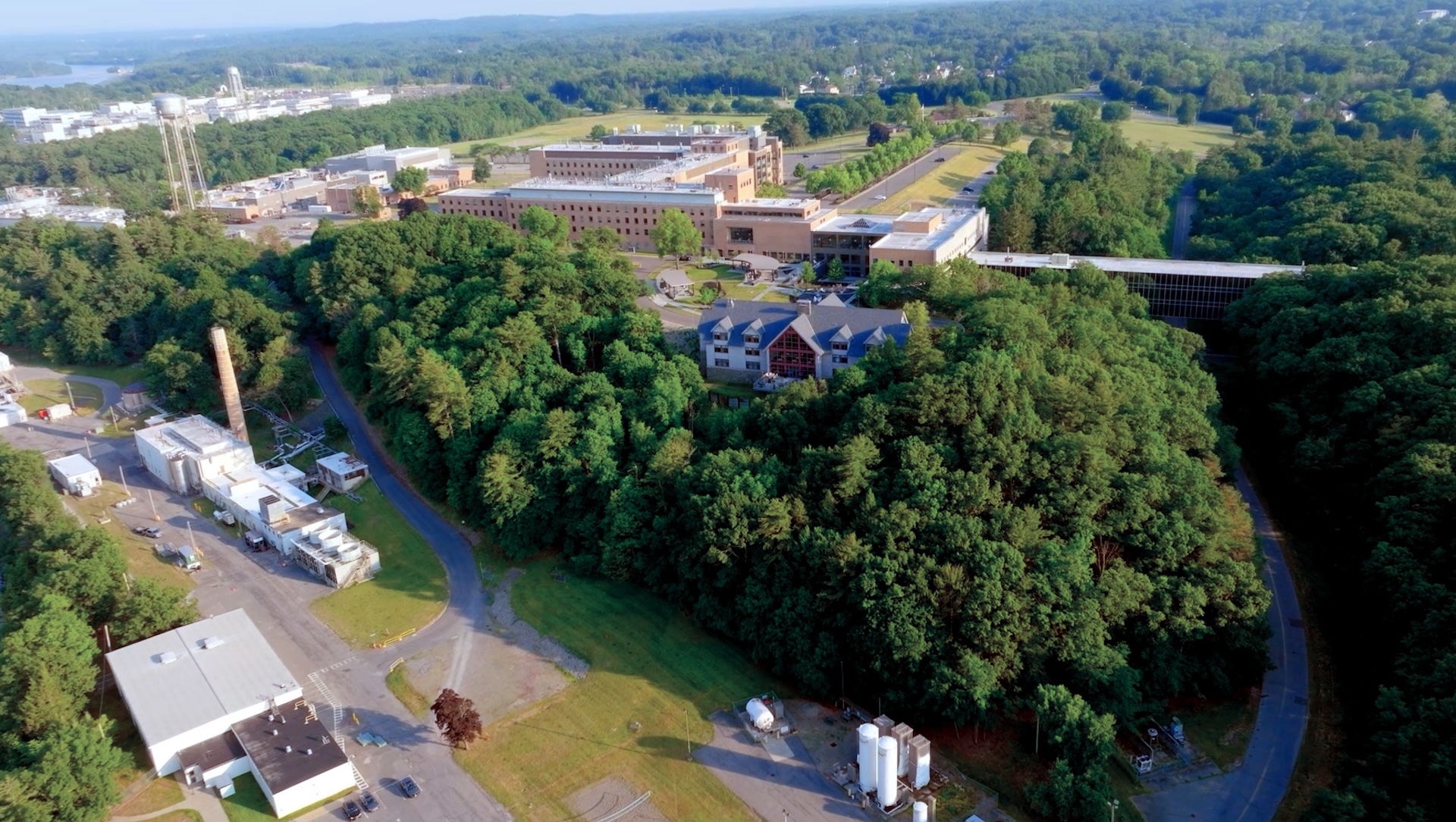
A critical manufacturing hub for military aircraft engines spread over 100 acres and home to roughly 2,500 employees, GE Aerospace’s facility is in many ways a town of its own, with a strong connection to the larger city of Lynn. McCarron is one of many Lynn natives who work at the site. After studying engineering in college and directing lean operations at various companies around the world, he found his professional home in the same plant where his grandfather and great-grandfather had previously worked.
The campus is sprawling. “We make rotating and structural components, as well as assemble and test engines,” says McCarron. “We have logistics, a full infrastructure team, engineering, program management, sales, business development.” As they’ve retired some manual equipment and moved into computer numerical control (CNC), robotics and other advanced technological processes, Lynn’s engineering teams have shifted into developing and producing new powerplants, such as the T408 and T901 turboshaft engines for helicopters, in addition to continuing to produce the T700/CT7 for helicopters, F404 and F414 military engines for fighters and trainers, and the CF34 commercial engine for regional jets.
“This site has always had momentum from the mission we all share,” McCarron says. “A lot of people here are incredibly smart, resourceful, full of spirit and integrity, but they also have this sense that what we do here genuinely matters. It’s something passed down from generation to generation, myself included, and there’s an immense sense of pride that goes along with it.”
“Lynn’s mission is to give every competitive advantage possible to our military,” McCarron says. “We don’t just make aircraft engines here; we make the best aircraft engines in the world. No one can touch what we do here.”
A focused strategy over the past several years has already produced positive results. By prioritizing safety, quality, delivery, and cost — in that order — McCarron says that the site has slashed the number of reportable injuries in half since 2022 and increased engine output by 26%. The bold new reminder at the entrance testifies to the legacy that makes it possible. “Seeing that sign, with the engine lit up and all the colors showing, really sets a tone about how special the site is,” says Rob Parsons, the site HR leader.
The sentiment runs deep.
“I always say that, if I retired and didn’t have anything to do, I’d still want to come here every day,” says Bill Steyer, a specialist in engine installation and performance who joined the company in 1965. “Designs evolve, materials evolve, technological applications and interactions evolve. I’ve found serious people ever since I started here and have for 60 years. They all have slightly different approaches, but they’re all fun to work with. And I can’t wait to see what we do next.”
See other posts
GE Aerospace is a world-leading provider of jet and turboprop engines, as well as integrated systems for commercial, military, business and general aviation aircraft.