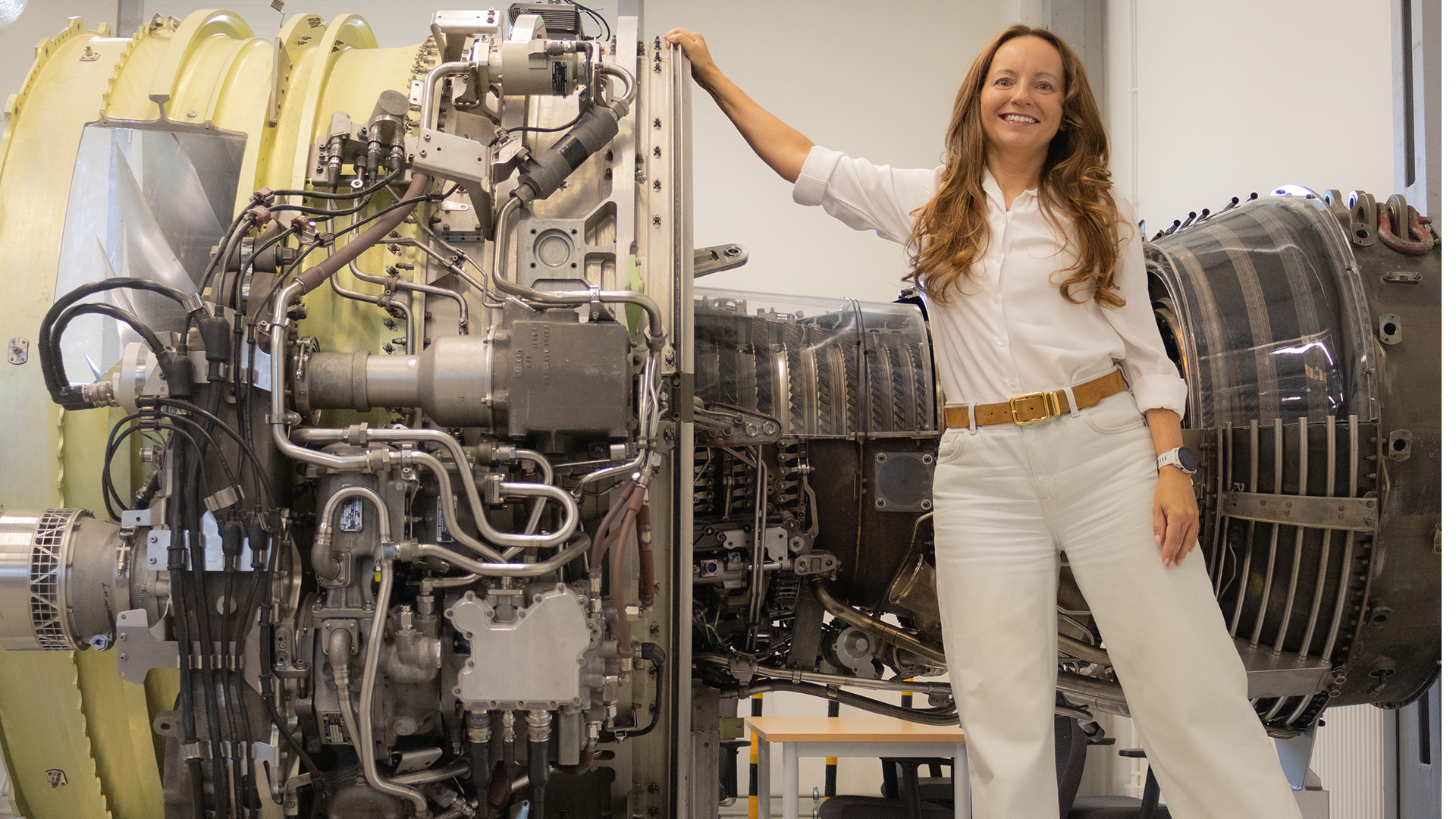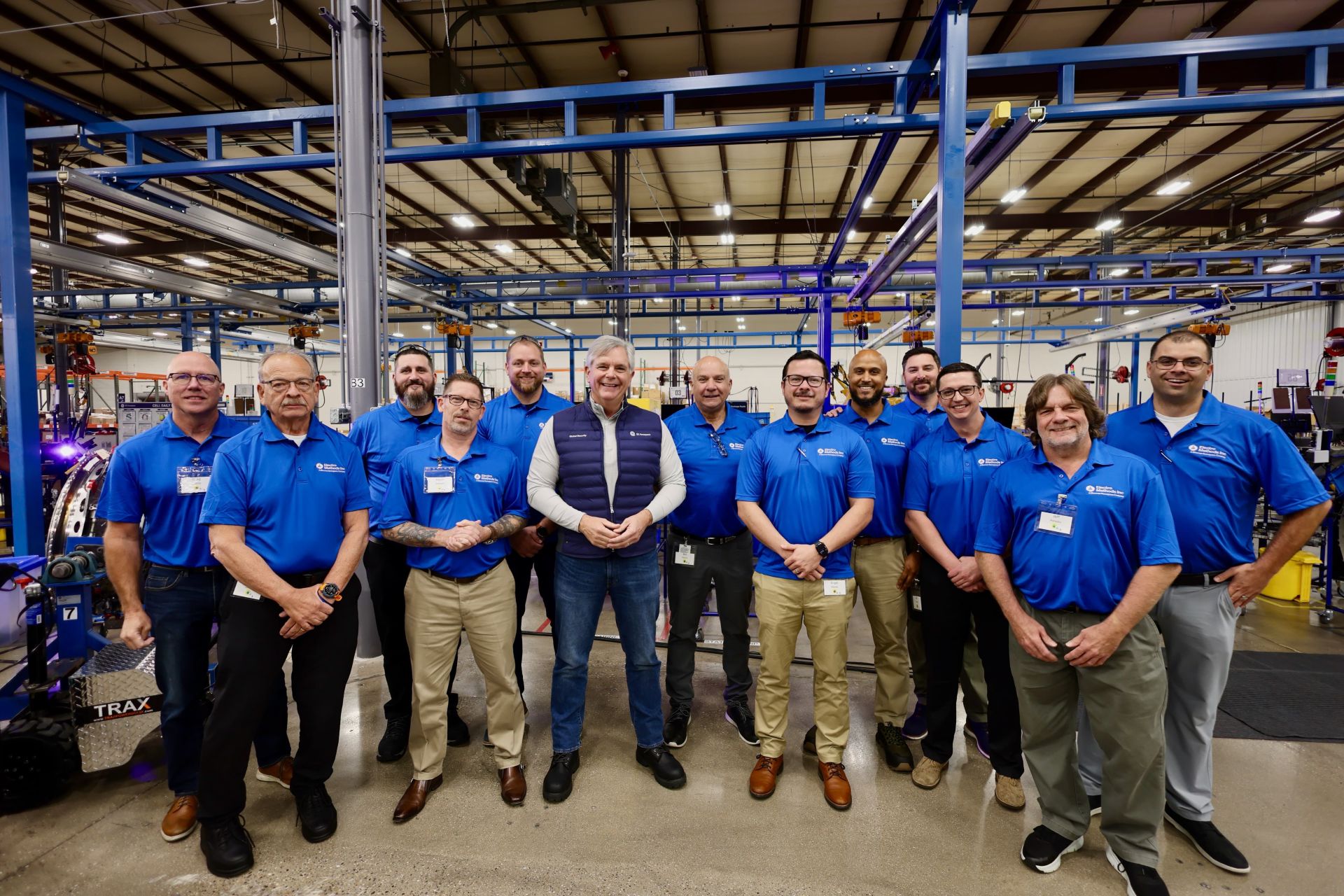
GE Aerospace Chairman and CEO Larry Culp photographed with a group of EMI employees who traveled to GE Aerospace’s facility in Terre Haute, Indiana, last fall to take part in a FLIGHT DECK workout to build problem-solving skills. Images credit: Electro Methods Inc.
Article
Hand in Hand: A Connecticut Supplier and GE Aerospace Lift Off
March 9, 2026 | by Christine Gibson
In 2018, on a patch of woodland a little over a mile from the Connecticut River, Electro Methods Inc. (EMI), broke ground on a 60,000-square-foot addition. Founded in South Windsor, Connecticut, in 1965, the aerospace component manufacturer had steadily grown to 178 people, but its leaders saw that the next 50 years would bring a new phase of growth. The addition opened its doors last year, just in time to help EMI fulfill hundreds of millions of dollars in new orders.
Many of those orders have come from GE Aerospace as the company ramps up production throughout its commercial engine portfolio, particularly its latest-generation narrowbody engine, the CFM LEAP.* But the company can’t do it alone. Suppliers like EMI play a crucial role in helping deliver for customers, and GE Aerospace partners with them so they have the resources to sustain the growth.
As part of that effort, GE Aerospace is investing in EMI and other suppliers’ people and operations through a $100 million commitment to GE Aerospace’s external supplier base for tooling, dies, and other fixtures in 2026 — one component of its $1 billion investment in U.S. manufacturing. Investments like these helped boost material input from priority suppliers by 40% over the previous year, which enabled the company to deliver a record-high number of CFM LEAP engines.
EMI makes hundreds of parts for the company’s commercial and defense engines, using thousands of different tools designed specifically for those production lines. Amid a decade-long surge in demand for narrowbody aircraft, EMI is using its new capacity in part to double its output for CFM LEAP engines.
“The investment is helping us strengthen our ability to make parts safely, with flawless quality, at rate,” says Craig Gallagher, CEO of Stronvar Aerospace, EMI’s parent company. “It’s part of our long-term collaboration with GE Aerospace, and our mutual dedication to developing skills so we can keep growing.”
“We continue to see growing demand across our commercial, military, and services businesses,” says Jonathan Blank, vice president of supply chain for GE Aerospace. “Delivering at the rate our customers need us to will require continued investment of time and resources to ensure our suppliers are growing with us. We’re making strong progress thanks to partners like EMI.”
A Team Effort
GE Aerospace’s supplier partnership doesn’t end with extra investment. As commercial travel demand places greater needs on engines — for improved fuel efficiency and longer time between shop visits — component designs are becoming more complex. And the more complex the product, the deeper the collaboration must be between GE Aerospace and its suppliers.
“When you’re fabricating assemblies from eight or nine parts, welding different kinds of metal, you’ve got to work hand in hand throughout the design and production process,” Gallagher says.
To strike the balance between innovation and manufacturability, engineers from EMI and GE Aerospace fine-tune designs together, tweaking dimensions or simplifying geometries to meet micron-scale tolerances as efficiently as possible.
“The process is beneficial for both teams, because we all want to make a part that’ll work,” says Bill Soucy, EMI’s president. “It’s a rare day that I’m not on the phone with an engineer at GE Aerospace. We’re on a first-name basis with most of them.”

Another Type of Investment
To get the most out of every element of production, GE Aerospace is also investing in EMI’s operational capabilities. EMI was the first supplier invited to attend a training session in the foundations of FLIGHT DECK, GE Aerospace’s proprietary lean operating model. Last fall, Soucy brought 14 EMI employees to the GE Aerospace site in Terre Haute, Indiana, to build their problem-solving skills.
“We wanted to make the business more efficient, and GE Aerospace offered to share their FLIGHT DECK tools and processes with us,” Gallagher says. “It was a great opportunity, and it showed the commitment both sides have to this partnership.”
“The power of FLIGHT DECK is that it can be applied outside the walls of GE Aerospace,” says Blank. “It’s a catalyst for partnership and is helping us pivot from transactional relationships with our suppliers to true, on-the-ground partnership where we work together to solve problems and unlock capability.”
Taking those lessons back to Connecticut, the EMI team immediately began to transform their operations, improving flow and reducing waste. Previously, units on a particular line had traveled two and a half miles over the course of fabrication and assembly, moving between buildings 10 times. Using lean principles, Soucy and his colleagues shortened the production path by a factor of 10 — which will pay dividends as the facility begins to manufacture more than 1,000 of these parts a year.
Still Growing After All These Years
Now in its seventh decade, EMI is continuing to expand its workforce to meet demand. The staff — which has grown to 250 fabrication engineers, machinists, toolmakers, quality engineers, and technicians — is mostly homegrown, developed by apprenticing rookies alongside shop-floor veterans.
Because the company controls the full manufacturing process for its products, EMI is an attractive choice for young job seekers who want to gain experience in a variety of disciplines. Many start as drivers, wash tank operators, or maintenance techs and work their way up to the highest levels of leadership — including a current vice president of operations who joined the company as summer help. Voluntary staff attrition hovers around 5%. As the company builds on its success, that stability ensures that skills mastered and lessons learned on the shop floor will endure.
“Our culture and the trust GE Aerospace has in us are helping us grow,” Gallagher says. “We’re always trying to get better so we can increase output and win the future.”
“EMI is a strong partner to us,” Blank says. “They are excellent problem solvers and collaborate closely with us to execute and deliver for our customers.”
*CFM LEAP engines are a product of CFM International, a 50-50 joint company between GE Aerospace and Safran Aircraft Engines.
See other posts
GE Aerospace is a world-leading provider of jet and turboprop engines, as well as integrated systems for commercial, military, business and general aviation aircraft.