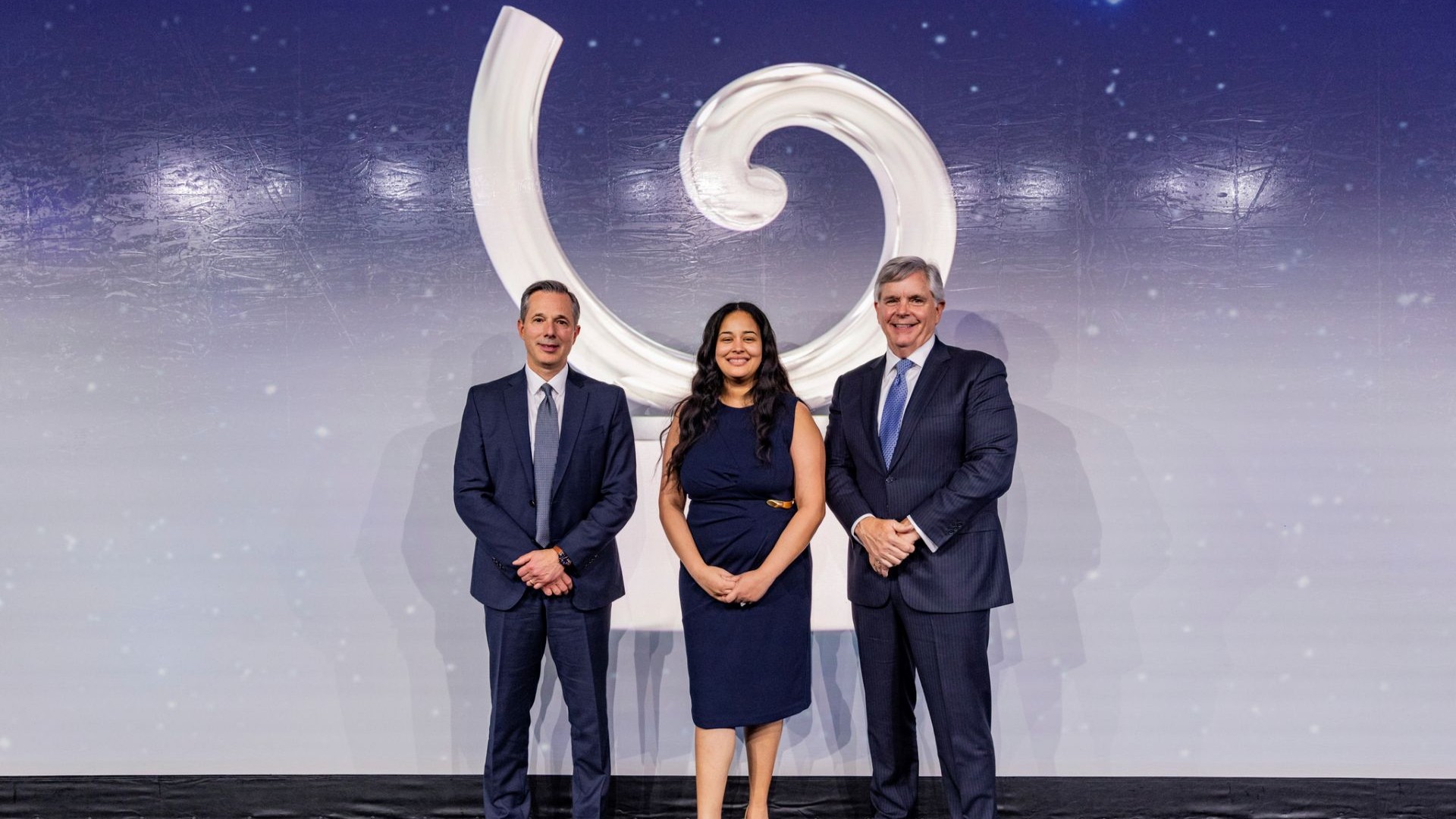
Amber Beebe (center) standing with (from left) Chief Human Resources Officer Christian Meisner and Chairman and Chief Executive Officer Larry Culp at the 2026 GE Aerospace Altitude Awards. Beebe and her colleagues Gabrielle Boesenberg and Dev Rajakrishna were all honored as Developers of World-Class Talent. Images credit: GE Aerospace
Article
Meet Three Leaders Using FLIGHT DECK to Lift People — and Processes — Higher
August 24, 2026 | by Dianna Delling
Amber Beebe, Gabrielle Boesenberg, and Dev Rajakrishna have very different roles at GE Aerospace. But they’re each finding new ways to work — solving problems, streamlining workflows, and forging new paths to success — through a commitment to safety, quality, delivery, and cost, always in that order, and FLIGHT DECK, the company’s proprietary lean operating model. For demonstrating exceptional leadership in their efforts to help their colleagues drive progress through FLIGHT DECK, these three leaders were honored with 2026 GE Aerospace Altitude Awards as Developers of World-Class Talent. Here’s what makes each of them stand out, and what they’ve learned so far on their lean journeys.
Amber Beebe: Shining Her Light on FLIGHT DECK
Amber Beebe wasn’t always a true believer. Though she often used lean operating tools as a young process engineer, she didn’t fully embrace them.
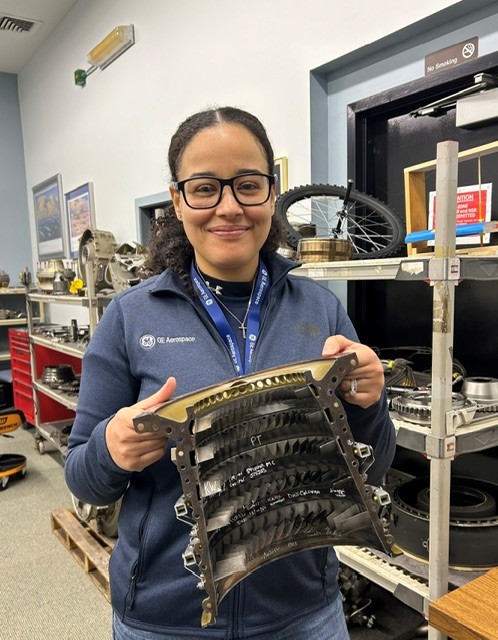
It took working in an environment that lacked a continuous improvement mindset for Beebe to declare her lean loyalty. “I thought, Where is the standard work? How can we problem-solve? Nothing is organized!” she recalls of that experience before joining the company. “That’s when I realized, I’ve been converted! Since then, I’ve been a huge lean advocate.”
Today, Beebe is a senior FLIGHT DECK leader for GE Aerospace’s Future of Flight teams. Since May 2024, it’s been her job to help engineers developing next-generation technologies to use FLIGHT DECK to boost process efficiency and outcomes.
In 2025, Beebe helped to create a daily management boot camp, an immersive, four-day workshop that’s now been completed by more than 300 frontline Future of Flight leaders at sites around the globe. During a kaizen event last November, she helped launch a network of sprint teams, creating a new design workflow with clear standard work, regular team check-ins, and virtual collaboration.
“We took a long design process and broke it down into six-week cycles,” she says, explaining that after each cycle, or sprint, project stakeholders shared feedback, which design engineers could then address in the next six-week cycle. “That way, you don’t get to the end and find out there are a bunch of things that need to be changed, which adds additional time.” Using sprints, the design team met their conceptual design review deadline.
Beebe has seen positive responses to FLIGHT DECK — and when someone is skeptical, she’s ready to help change their mind.
“I love working with people who say, ‘It doesn’t apply’ or ‘This won’t work for me,’ because that was me once,” Beebe says. “When you get them to understand the principles and it helps them with the way they do their work, that’s a win for them and a win for the team. It’s energizing.”
Gabrielle Boesenberg: Putting People First for Long-Term Success
When Gabrielle Boesenberg took a role as business operations leader for the CF34 engine families, just over a year ago, she made a commitment. “I told myself that no matter what, I was going to put people first on my team,” she says. “If somebody needed help with something, I’d put them at the top of my priority list.” That people-first mindset reflects one of the core behaviors behind FLIGHT DECK: respect for people.
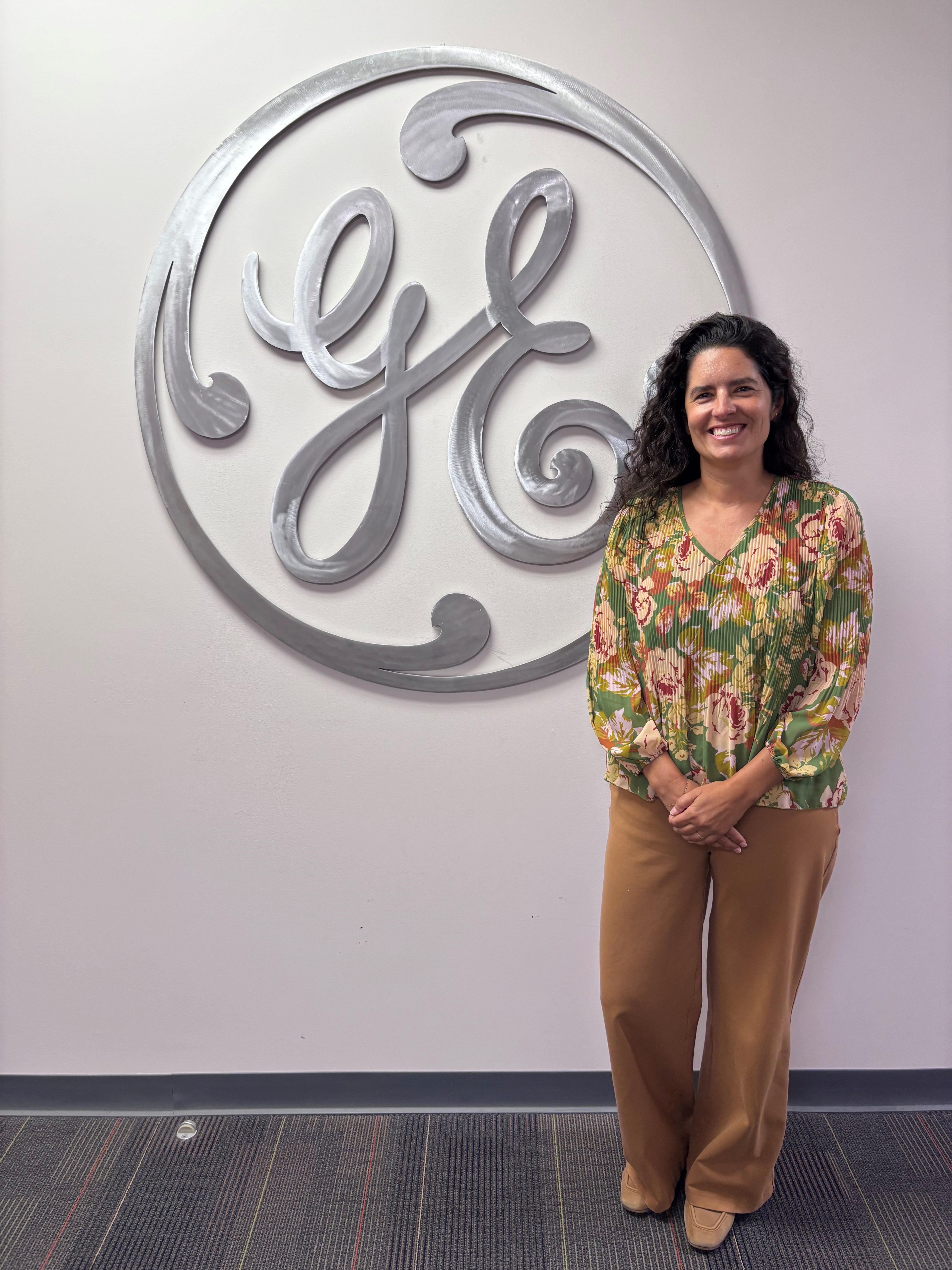
It’s a strategy she’d picked up since joining GE Aerospace through the Operations Management Leadership Program nearly 20 years ago. Business pressures will always be there, she explains, “but if you invest time in your people, they’re going to perform, and the team as a whole is going to perform. Sometimes you have to go slow to go fast.”
With a strong focus on continuous improvement, her extended team spent 2025 identifying opportunities to streamline operational and financial processes across their organization. Their efforts led to a redesign of the CF34 service kit claim process, which yielded significant savings for the company.
“We tried to find areas where we were not being as efficient as we could be,” she says. “We used a structured problem-solving approach to develop an action plan and countermeasures to close some of the [financial] gaps we found.”
One of her earliest challenges was building a team from the ground up and helping everyone adopt FLIGHT DECK. “I really focused on coaching the team on our customer-driven priorities, our financial priorities, and finding ways to leverage FLIGHT DECK to create win-win solutions,” she says.
Once again, the “going slow to go fast” philosophy guided her approach. “At first, the FLIGHT DECK fundamentals can seem uncomfortable, and that’s okay,” she says. “It’s like that whenever you start building any new muscle. It takes doing it over and over to build muscle memory.”
Over time, lean thinking becomes second nature. “That,” she says, “is when the real breakthroughs can happen.”
Dev Rajakrishna: Thinking Bigger
At the start of 2025, a slew of new business — including a subcontract to develop avionics systems for Bell Textron’s MV-75 tilt-rotor aircraft, part of the U.S. Army’s Future Long Range Assault Aircraft program — presented a new challenge for the GE Aerospace engineering team in Grand Rapids, Michigan. To ramp up and meet critical deadlines, they needed to fill 120 new engineering positions.
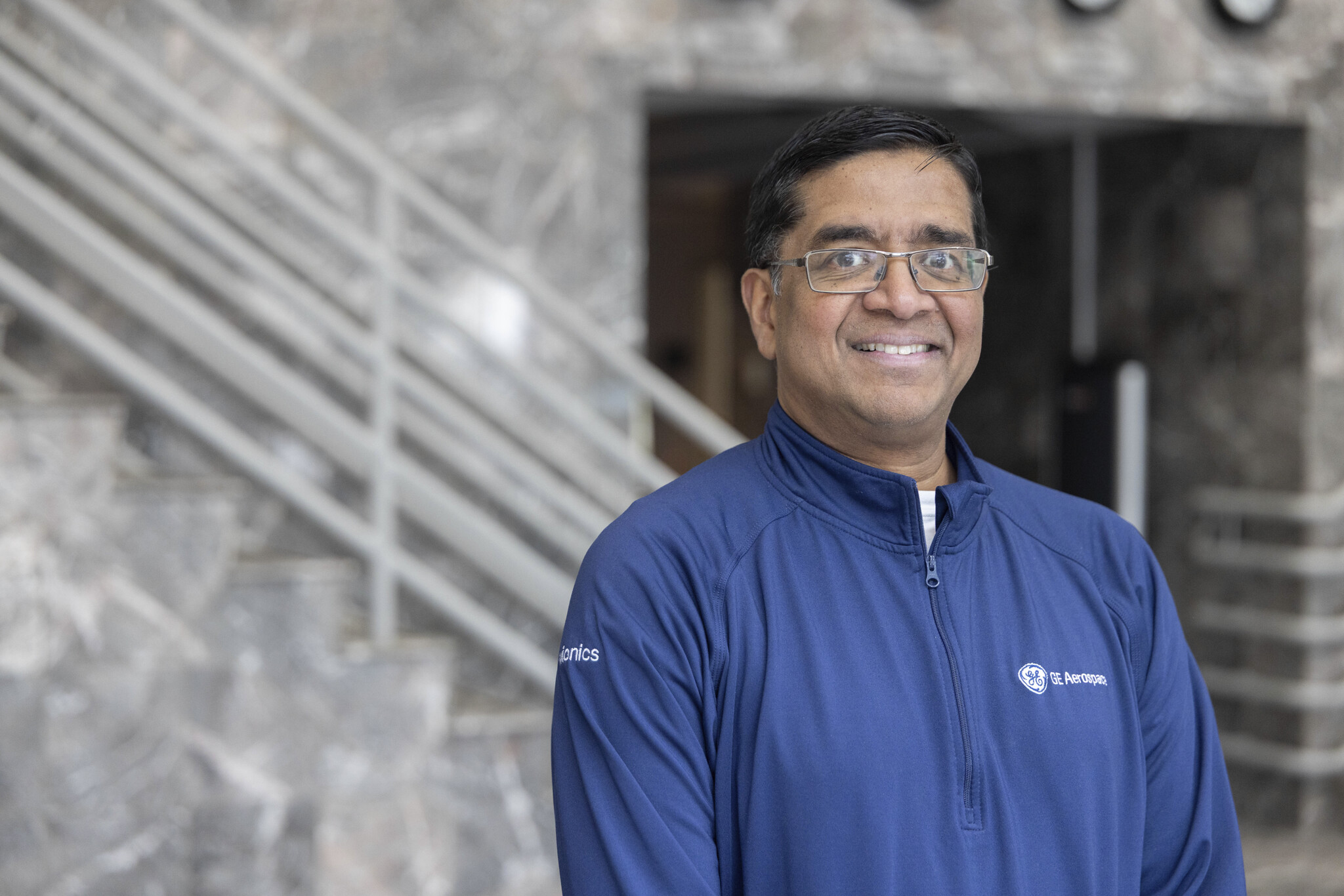
“We started out hiring the way we usually did, adding people one or two at a time,” says Dev Rajakrishna, who was then executive engineering leader for computing, networking, and missions systems at the site. “But with that many positions to fill, we soon realized that we needed to think bigger.”
Rajakrishna turned to the FLIGHT DECK toolbox for guidance. In March, he launched a “Tiger Team,” a group of seven senior leaders who created a regular operating cadence around talent acquisition, meeting every Friday at 8 a.m. to validate progress, address obstacles, and maintain momentum. Every open position became an active item on a spreadsheet, to be evaluated each week. Each line item was assigned a “state” to show its status, and the team developed action plans to guide them in moving each line item from one state to the next, until a position was successfully filled. Activities in support of accomplishing the action were proactively addressed ahead of the weekly operating review each Friday, which allowed the group to focus more on problem-solving and removing roadblocks during their meeting. By November, nearly two months ahead of schedule, they’d hired a highly skilled engineer for every position.
“FLIGHT DECK gave us the rigor, discipline, and structure we needed,” says Rajakrishna, who this past October became executive leader for avionics and electrical power in the Chief Engineer’s Office. “Using FLIGHT DECK principles helped us establish a visible rhythm, such that everybody knew the piece they needed to accomplish to reach the larger objective.”
It also created a new hiring approach that was more focused and scalable and is still being used today. “If you go to genba with the team now, months after I’ve moved to a different job, this initiative continues,” he says. “They are still adding people in that way, using that rhythm. That, to me, is my proudest accomplishment: that we put something in place that was sustained to bring benefit to the business.”
Across very different roles and challenges, Beebe, Boesenberg, and Rajakrishna demonstrate the power of FLIGHT DECK to unlock better ways of working. Their leadership shows that lean is more than just driving efficiencies — it’s about developing people, building momentum, and sustaining improvements that help teams better serve customers.
See other posts
GE Aerospace is a world-leading provider of jet and turboprop engines, as well as integrated systems for commercial, military, business and general aviation aircraft.