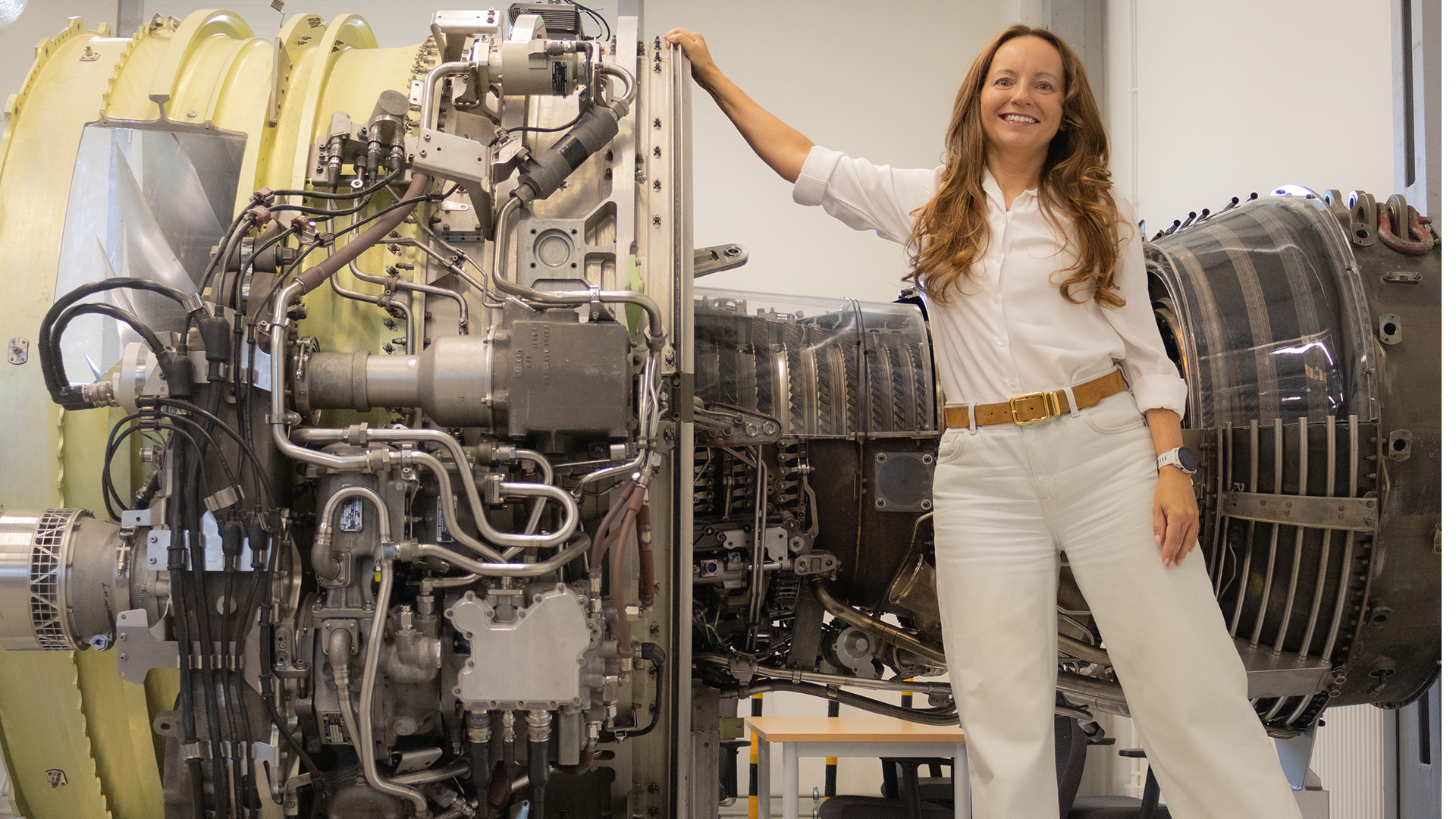
Phoenix Specialty Mfg. Co. was honored recently as GE Aerospace’s 2026 Supplier of the Year. The company prides itself on its unique culture, responsiveness, and flexibility. “Our decision-making power is here in the facility, and we’re set up to react very quickly,” says Allison Penick, Phoenix’s sales manager. Image credit: GE Aerospace
Article
Pulling Through: GE Aerospace’s 2026 Supplier of the Year Works Hard to Keep Parts Moving
August 31, 2026 | by Chris Norris
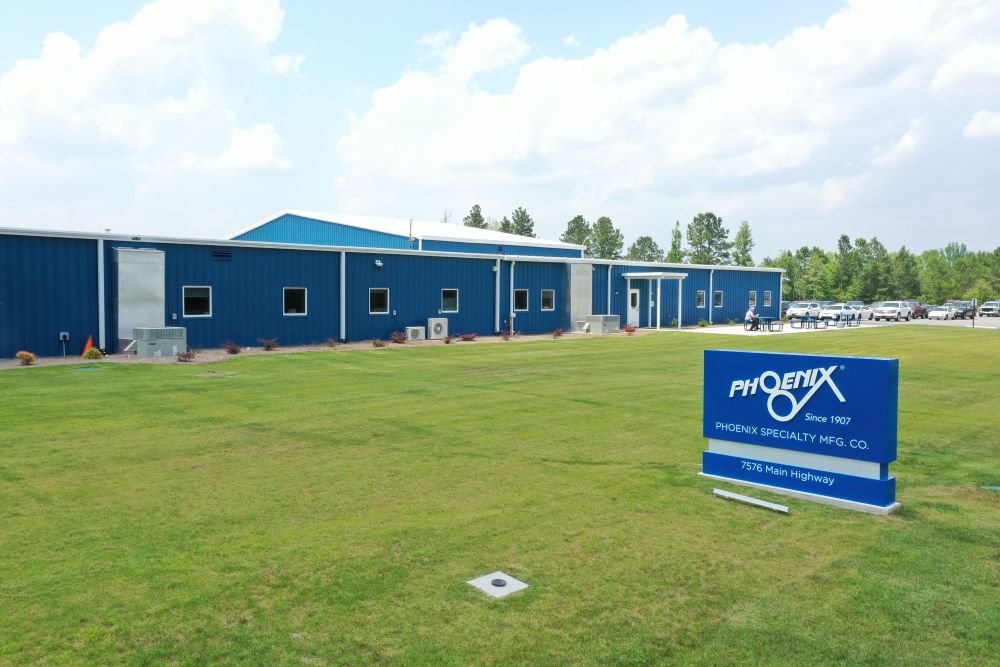
Phoenix Specialty Mfg. Co. sits in a rural corner of South Carolina’s Lowcountry. It’s a small company with a big footprint, manufacturing precision shims, washers, seals, spacers, stampings, and simple brackets for more than 1,600 companies each year. Phoenix Specialty also happens to be a model partner in GE Aerospace’s transformed approach to its supply chain.
Beginning in 2024, GE Aerospace decided to reset its relationship with its supply base. The transactional approach of the past had resulted in miscommunication and distrust, so it started partnering closely with suppliers as a critical extension of its own operations. Earlier this year the company announced a $100 million investment in its external supply base as part of its $1 billion investment in U.S. manufacturing. Direct investment with suppliers helps ensure they have the equipment and tooling to keep up with demand.
GE Aerospace has also worked to stabilize demand signals, so suppliers receive a consistent, growing rate of demand that gives them confidence to invest in their operations and grow capacity. Additionally, the company is partnering with suppliers to deploy FLIGHT DECK, its proprietary lean operating model, at their facilities to eliminate bottlenecks. This work is showing signs of success: GE Aerospace’s engine deliveries increased by 31% in the second quarter of 2026, thanks in part to double-digit growth in material input from priority suppliers over the past nine consecutive quarters.
This is where Phoenix comes in.
Through intensive internal collaboration with operations teams from its shop floor to its inventory shelves, Phoenix exemplifies what good looks like, and GE Aerospace has held it up as a model to establish more consistent practices with all of its suppliers. Throw in a clutch performance last summer and it’s easy to see why GE Aerospace recognized Phoenix as its 2026 Supplier of the Year.
“We’ve learned that finger-pointing gets us nowhere. Instead, we’re working with our suppliers to grow together as one team,” says Jonathan Blank, GE Aerospace’s vice president of supply chain. “Phoenix is a strong partner to us, and they see our customers as their customers. There’s a level of trust and collaboration that goes beyond a transactional business relationship.”
First ‘On Pull’
The two companies go back a ways. Phoenix, a fourth-generation, family-owned company founded in New York, began doing business with GE Aerospace in the 1950s. It continued to supply the company with specialty washers, shim seals, gaskets, spacers, brackets, and other elemental parts after relocating to South Carolina in the late 1960s. “Today we supply parts for most of GE Aerospace’s commercial and military engines, including the CFM LEAP,”* says Heather Bishop, Phoenix’s customer service representative lead.
In the 1990s, Phoenix became one of the first companies to earn AS 9100 certification, ensuring that it met global industry standards for aerospace manufacturing. It continued to distinguish itself, first by joining GE Aerospace’s Min-Max program, a lean-based inventory initiative that establishes minimum and maximum thresholds for parts on hand, then by becoming one of the first of the company’s suppliers to be fully “on pull.” Pull production, a priority at GE Aerospace since 2024, means parts are shipped on demand, in the exact quantities needed, to minimize excess inventory and waste.
Phoenix was set up to reach this status more quickly. “We carry large raw-materials and finished-goods inventories for our customers as part of our business model,” says Allison Penick, Phoenix’s sales manager. The company was an early adopter of GE Aerospace’s PFEP initiative, or “plan for every part,” a dynamic, lean-based database that tracks how each part is sourced, handled, and stored to optimize the entire supply chain.
“We take our relationship with GE Aerospace very seriously,” Penick says. “Over the years, we’ve always tried to be a model supplier.” And in July 2025, Phoenix proved how serious they are about living up to it.
Built to Pivot and Serve
GE Aerospace was awaiting an order of LEAP engine components last summer when another supplier told them it would be unable to deliver. They quickly got in touch with Phoenix.
“They notified us and asked if we could step in to support this critical part,” Penick recalls. “We got off the call with GE Aerospace, sat in the conference room, and came up with a plan to get those parts made and out of our facility within 24 hours.” And that’s just what they did.
Penick credits Phoenix’s employees, who are “some of the best people anywhere for a situation like this,” she says. “The troops rallied, and it took every department to make it happen: materials, machine shop, production, quality, sales, customer service, shipping — everyone pulled together.”
The rest of the credit goes to Phoenix’s unique culture. “Since we are family owned, we have more flexibility,” Penick explains. “Our decision-making power is here in the facility, and we’re set up to react very quickly. In this case, we created a timeline and a work order, ensured that we had materials, and, since we have an in-house machine shop, we were able to manufacture the parts very quickly.”
Phoenix already has in place many of the robust, lean-aligned processes embraced by GE Aerospace — everything from demand forecasting and capacity modeling to deeper supplier collaboration. So it’s hardly a surprise that Phoenix was invited to participate in the company’s global supplier symposium, held earlier this year.
As GE Aerospace continues to scale transparency, stability, and collaboration across its supply base, Phoenix stands as an exemplar for supplying the future of flight.
“One of our company values is a customer-first mentality,” says Penick. “We are proud that we successfully demonstrated our commitment to GE Aerospace and look forward to continuing our partnership and supporting their growth, success, and transformation.”
* CFM LEAP engines are produced by CFM International, a 50-50 joint company between GE Aerospace and Safran Aircraft Engines.
See other posts
GE Aerospace is a world-leading provider of jet and turboprop engines, as well as integrated systems for commercial, military, business and general aviation aircraft.