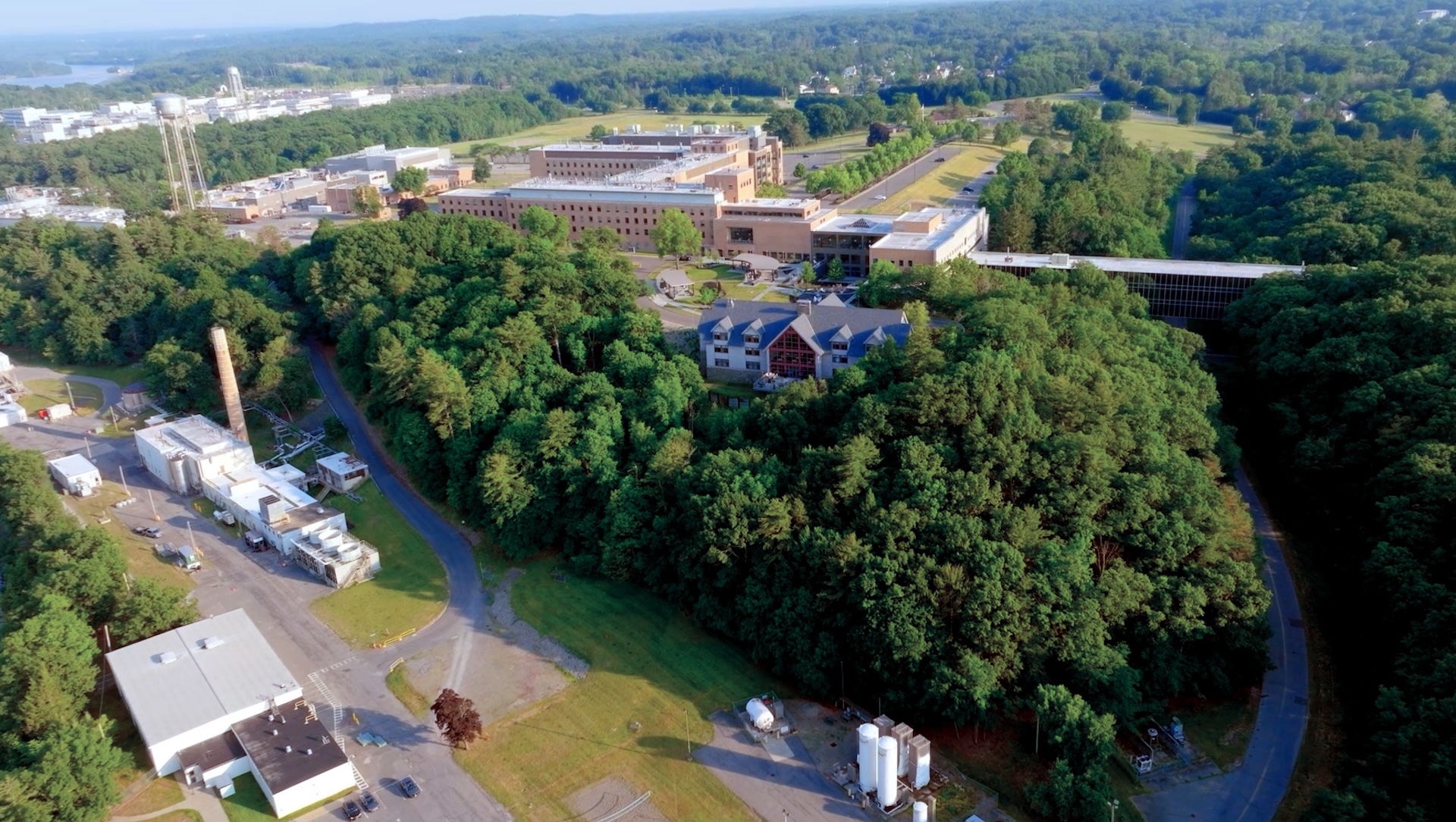
The Research Center campus in Niskayuna, New York. Credit: GE Aerospace
Article
5 Things to Know About the GE Aerospace Research Center
September 30, 2026 | by Dianna Delling
GE founder Thomas Edison had the right idea: If you want to fuel innovation, gather the brightest minds, give them access to state-of-the-art tools, and encourage experimentation. That’s why GE Aerospace’s recent $225 million commitment to update the GE Aerospace Research Center, the company’s renowned technology development facility in Niskayuna, New York, is so important. The massive modernization project, supported by the State of New York and the Schenectady County Metroplex Development Authority, will add 75 new full-time employment opportunities in the region and set the stage for decades of advanced research and technological progress. “We are ready to turn this investment into breakthroughs that will define the next era of aviation,” says Joseph Vinciquerra, general manager and senior executive leader for GE Aerospace Research. Here are five reasons why the GE Aerospace Research Center remains a global hub for innovation.
1. It was the first industrial research laboratory in the United States. Founded in 1900 by three GE employees in an upstate New York barn, the workshop originally known as General Electric Research Laboratory was inspired by Edison’s “invention factory” in Menlo Park, New Jersey. The lab quickly outgrew its humble quarters, moving to the company’s Schenectady offices in 1901 and expanding to its current campus, in nearby Niskayuna, in 1950.
2. It’s a proven hotbed for materials innovation. Carbon-fiber composite fan blades and ceramic matrix composite (CMC) materials developed at the Research Center continue to be game changers for jet engine efficiency and durability. Fourth-generation carbon-fiber composite fan blades, first introduced in 1995 on the GE90 engine, will spin on the GE9X, the most powerful commercial engine in history, when it debuts on the Boeing 777X next year.
3. The Research Center’s 28,000-square-foot “clean room” supports an elite power electronics research team. Silicon carbide (SiC) semiconductor research requires a pristine, dust-free environment, so air in the clean room, a facility roughly half the size of an American football field, is filtered to be thousands of times cleaner than air in a typical home or office. GE Aerospace teams there recently demonstrated a new SiC device representing a step change in efficiency and power density. This technology platform played a key role in the world’s first high-altitude hybrid-electric test flight, announced in July.
4. The computational fluid dynamics team has harnessed the power of Frontier, the world’s fastest supercomputer. Through a partnership with the U.S. Department of Energy’s Oak Ridge National Laboratory, GE Aerospace researchers are using Frontier to design next-generation technologies like Open Fan engine design for the CFM RISE program. Capable of more than a quintillion calculations per second, the supercomputer can model the aerodynamic and acoustic performance of a full-scale engine, potentially shaving years off the engine design process.
5. It’s a hub for hypersonic propulsion development, accelerating breakthroughs for flight at five times the speed of sound. Technologies developed and demonstrated at the Research Center — like the rotating detonation combustion (RDC) ramjet engines demonstrated in late 2025 — could enable faster flight than previously known, boosting national defense capabilities and changing the way people travel. In May, GE Aerospace researchers showed off a new generative AI–powered application that helped engineers produce the preliminary design for a hypersonic ramjet in just seconds.
See other posts
GE Aerospace is a world-leading provider of jet and turboprop engines, as well as integrated systems for commercial, military, business and general aviation aircraft.