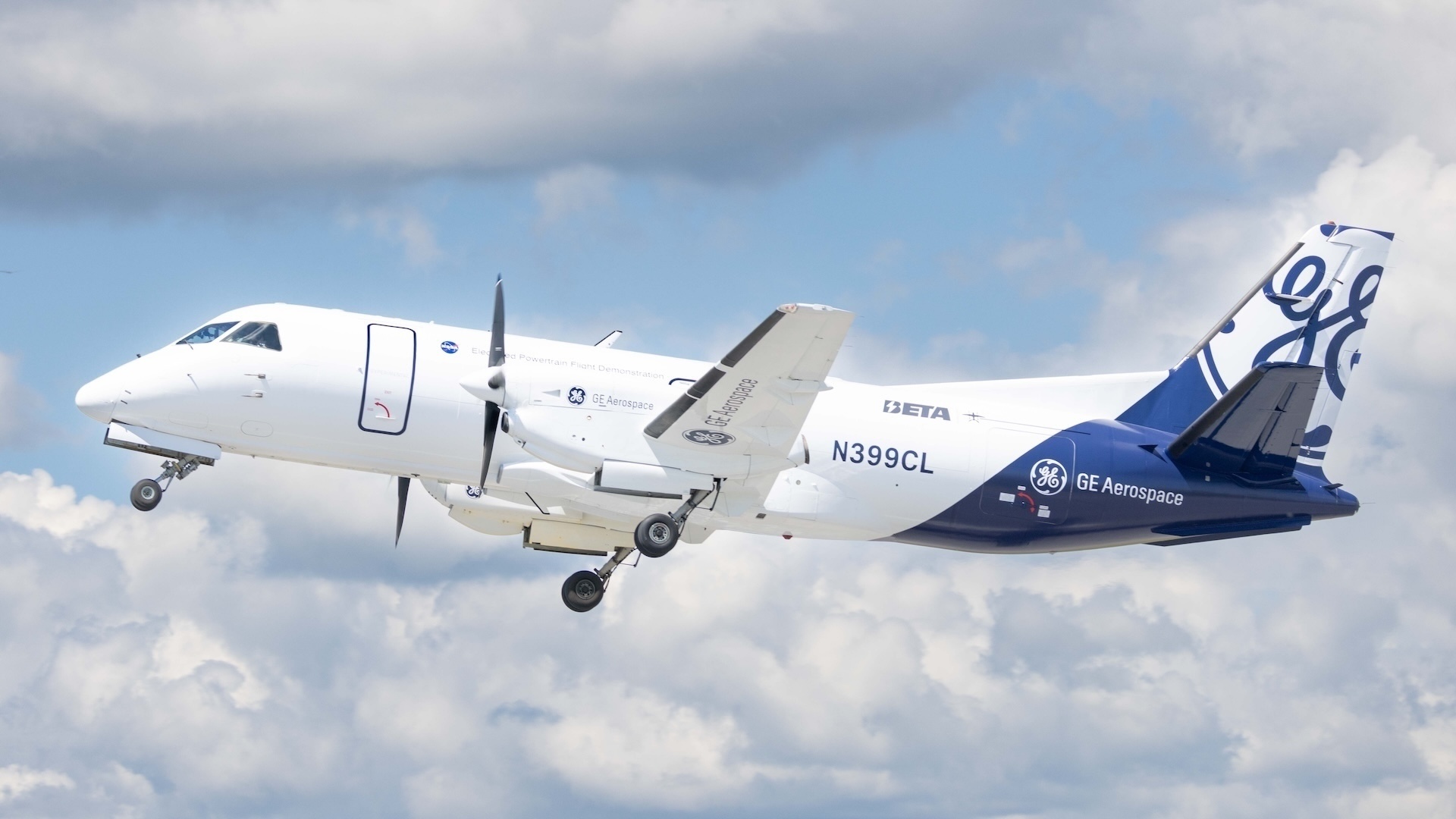
GE Aerospace's modified Electrified Powertrain Flight Demonstration (EPFD) aircraft completed the world’s first high-altitude hybrid electric flight in May, as well as the first hybrid electric flight across the Atlantic Ocean en route to the Farnborough International Airshow in July. Images credit: GE Aerospace
Article
How Bengaluru Brain Power Is Helping Advance the Future of Flight
August 18, 2026 | by Chris Norris
In his 26 years at GE Aerospace, Consulting Engineer Nitesh Jain has learned to expect great things from his colleagues at Bengaluru’s John F. Welch Technology Centre (JFWTC). One of the company’s largest multidisciplinary centers for research and development outside the United States, the JFWTC has long collaborated with other global research centers to produce key innovations for the future of flight. Now, with the company riding a wave of media attention for the advances in high-altitude hybrid electric flight technology announced at the recent Farnborough International Airshow, Jain points to a step change that’s significant even for the Future of Flight teams in Bengaluru.
“In the past, we’ve worked on several engine lines — GE90, GEnx, GE9X, CFM LEAP* — and with each change of the center line, we’ve brought an additional 10% to 15% fuel benefit,” Jain says. “This time, we’re looking to double that.” Using next-generation propulsion technologies like Open Fan architecture, compact core, and hybrid electric systems, engineers of the CFM RISE* program have targeted a 20% leap in fuel efficiency over current engines while still meeting durability expectations, and they are drawing on the Bengaluru technology center’s combined expertise in a range of advanced aerospace technologies.
“We found the only way to get this kind of step change in fuel-burn efficiency without excessive weight and drag is to remove the constraints of the engine’s cover,” Jain explains. The ductless Open Fan design in the RISE program allows for a larger fan diameter, which in turn pushes more air around the compressor, producing more thrust. Internally, compact-core technology enhances capabilities inside the high-pressure compressor and high-pressure turbine. The combination of the unique fan blade system, aerodynamic design, advanced compact core, and adaptive cycle engine capability, which optimizes engine performance at every stage of flight, aims to boost durability and reduce dust ingestion in hot and harsh environments.
Pushing the envelope in this kind of space requires expertise in areas beyond conventional engine technologies. “It’s a combination of aerodynamics, thermal systems design, structures design, systems analysis, advanced materials, and additive manufacturing,” says Jain. “All these and more play a role in addressing future aviation demands — in weight, fuel burn, efficiency, operability, durability, and manufacturability.”
Demands that the engineering teams in Bengaluru are uniquely suited to meet.
Bending Physics to Speed Innovation
Take aeroacoustics, a field of particular importance to Open Fan technology. Since this architecture omits a noise-reducing nacelle, engineers needed to design quieter blades, which meant understanding noise sources. Ravish Karve, an advanced lead engineer at Bengaluru’s research center, pursued this collaboratively with GE Aerospace teams worldwide. Together they leveraged one of the world’s largest supercomputers — Frontier, based at the U.S. Department of Energy’s Oak Ridge National Laboratory in Tennessee — to run computational fluid dynamics software that simulated the air movement and acoustics of a full-scale Open Fan design. Frontier has the processing power of roughly 37,000 GPUs and can make more than a quintillion calculations per second.
“We found that we could bend some of the physics rules favorably for this particular application,” says Karve, who focused on the static outlet guide vanes (OGV) behind the front fan that guide air, which is subject to the intense distortion in a noise-producing wake. Research revealed that the optimal arrangement of these OGVs is a counterintuitively uneven placement around the engine — the kind of breakthrough that Karve anticipates seeing more often from Bengaluru’s research center.
“We’re currently working on AI projects and collaborating across engineering, research, and data science, all co-located at the same center,” he says. “In the era of AI, multiple models must be connected to each other, and having those voices co-located speeds innovation.”
An Interdisciplinary Effort
Some of the innovations adapt known technology, as in electric vehicles, to aviation. Bengaluru’s Senior Engineer Sumitha Mohan has spent four years adapting hybrid electronics for aircraft, where the technology faces much stricter, more diverse challenges. “Cars are designed to operate at sea level, at normal temperatures, with relatively few weight demands,” says Mohan. “With aircraft, you need systems as power-dense as possible, so as not to negatively affect fuel burn, and that can operate at high ambient conditions.” Not to mention at altitudes above 30,000 feet. “You can’t buy these kinds of conversion systems off the shelf,” she adds. “You need to design them.”
Mohan’s team is working on new hybrid electric systems that seek to replace traditionally pneumatic, hydraulic, or mechanical systems, and do so efficiently enough to help deliver the 20% leap in fuel efficiency that the RISE program is aiming for. The robust interdisciplinary environment at Bengaluru has been an advantage.
“One major breakthrough has been integrating a megawatt-scale hybrid system into an aircraft that can operate at altitude,” Mohan says. “That’s simply not been done before: taking the entire aircraft’s electrical system and making something that’s extremely efficient and operates seamlessly with whatever is currently on board the aircraft.” This advance has required thermal engineers, mechanical system designers, and a wide variety of experts in a tremendous range of fields. “It’s a very interdisciplinary effort with a multi-team network across different sites.”
‘A Lot of Teams Working Together’
The close proximity of engineers at the JFWTC enables them to move faster from idea to analysis, validation, and learning, as do India-based collaborators that include the National Aerospace Laboratory, Hindustan Aeronautics Limited (HAL), and the Indian Institute of Science. And this is just on the R&D side.
“On top of this, our services engineering team is co-located at the Bengaluru center, which provides in-region support to our airline customers in South Asia and the Middle East. This helps give us a deeper understanding of reliability, fuel burn, durability, maintainability, and turnaround,” Jain adds. “It’s about understanding how to deliver practical value in services.”
At the Farnborough International Airshow, GE Aerospace provided an in-depth look at the advances the company is making in high-altitude hybrid electric flight. But these breakthroughs only hint at how forward-looking the work being done in Bengaluru is, and how it contributes to technology maturation with a focus on safety, durability, and efficiency.
“A lot of technologies had to come together to make that happen,” says Jain. “A lot of teams working together, a lot of expertise that’s been tested in separate pieces, coming together as an integrated system for the first time. That tells the story of just how much success is behind the technology.”
* CFM LEAP engines are produced by CFM International, a 50-50 joint company between GE Aerospace and Safran Aircraft Engines. RISE is a technology development program of CFM. It is not a product offered for commercial sale.
See other posts
GE Aerospace is a world-leading provider of jet and turboprop engines, as well as integrated systems for commercial, military, business and general aviation aircraft.